Sunday, 11 March 2012

Shakespearean Tragedy: The New Cultural Idiom


Hamlet, Julius Caesar and King Lear in experimental forms

“He was not of an age, but for all time”. Ben Jonson’s epitaph for Shakespeare is as prophetic as it is reflective. His corpus supplanted its own temporal boundaries, and would annotate all future literary endeavour. If, though, Jonson’s tribute is to echo in pragmatic rather than solely rhetorical terms, then interpreters of Shakespeare must stress his pertinence through re-framing, re-appropriating, adapting anew in a manner that locates fresh and distinctive pathways within familiar dramatic territory. Jonson proposes a formula – modernity must verify its utility.

To be sure, contemporary perspectives have largely met the demands of that challenge. To cite just a handful of examples, Richard III (Richard Loncraine, 1995), with Ian McKellen in the title role, sets the story of the maligned King in a fictionalised 1930s Britain; William Shakespeare's Romeo & Juliet (Baz Luhrmann, 1996), often described as "Shakespeare for the MTV Generation", sees Leonardo DiCaprio and Claire Danes as the young lovers in a version that portrays the Montagues and Capulets as warring business empires on Verona Beach; whilst the BBC's ShakespeaRe-told (Mark Brozel et. al., 2005) offered modern perspectives on A Midsummer Night's Dream, The Taming of the Shrew, Much Ado About Nothing and Macbeth, the latter set in Docherty's Restaurant, where Joe Macbeth (James McAvoy), his maître d' wife Ella Macbeth (Keeley Hawes), and Billy Banquo (Joseph Millson) are angered that Duncan Docherty (Vincent Regan) takes credit for Joe's work, and seek guidance from three spectral refuse collectors. Whatever the virtues or shortcomings of such adaptations may be, each illustrates broadened textual possibilities and allied outlet for reconfiguring narrative and deriving cultural salience from present-day annotations and undertones. It is to this philosophy of revision that the pieces reviewed here committed themselves. (Criticism written for New Statesman magazine).      


Creation and the Factory capture the Conscience of the King in arresting style

IT could be said that playing the melancholy Prince represents the defining challenge of any actor's career. Yet, to be called upon, spontaneously, to portray not just the neurotic Dane but another character entirely - and who plays whom is ratified in a discursive prologue among the cast - surely puts a singularly demanding complexion on an already involved theatrical endeavour. This, though, is exactly the objective the stars of Creation Theatre’s Hamlet, collaborating with the Factory Theatre Company, have set themselves - to take on, at the will of their contemporaries, a different character each night, moving seamlessly between personalities and emotions, but as if "this" were the role for which they had always prepared. The prefatory interaction tallies with the refreshingly off-the-cuff ethos of the production that follows - these opening minutes are a glorified rehearsal, not afraid to show theatre as a warts-and-all process rather than a formalised, neatly executed piece. Such an approach avoids a stuffy intellectualism that views Hamlet as a sacrosanct, untouchable member of the Canon, instead enabling the play itself to resonate with the new perspectives Creation-Factory are bringing to bear on the drama. Director Tim Carroll is the ideal compere for the evening, leading the game of stone, paper, scissors as the actors allot one another their character. Gimmicky? Absolutely, and why not?


Director Tim Carroll.

This was the first time I had seen Oxford-based Creation in action. Given the fierce, genre-traversing intelligence of this powerfully inventive rendition of Shakespeare's tragedy, I couldn't help but regret my rather belated introduction to their work. Certainly, any doubts that playing different roles each night gives the performers time to get into that new part, to adequately canvass nuances of individuality and extremity, are soundly assuaged by the cast's commitment to adapting, revising, exploring anew. When off the stage, they are forensically examining the script, and, when they return to the centre of the action, they bring intuitive dexterity to rhetoric and expression. The Norrington Room of Blackwell's Bookshop, Broad Street, was a curiously appropriate venue. Hamlet is, of course, a Philosophy student at the University of Wittenberg, and Rhys Meredith, in the title role, delivering his pained monologues among shelves of humanistic thought, resonates with the stoicism and cautious intent with which Hamlet contemplates retribution. Such surroundings create a suitably cerebral base for the action, annotating the life of a character whose uniquely inquisitive outlook and scholarly vocation make one the most sobering epistemology and abrasive determinism. A superb Meredith, though notably understating his infamously faceted role, deftly projects Hamlet's stark conflict of will and restraint with an almost seductive intensity that engages our sympathy with his moral quandary rather than scepticism over its possible resolution. That there are no evident pretensions to "the definitive Hamlet" on Meredith's part reflects more broadly the spirit of the production - contentment to be different, subversively challenging, rather than cultivating a theatrical and cinematic tradition in a bid to nefariously join a culture of thespianism without proving itself eligible through some primary reading or interpretation. Indeed, it is expressly Creation's sharply perceptive offering of something new without following in the stylistic footsteps of other adaptations that illuminates its originality and renders it so beguilingly unselfconscious.


One could argue this version of Hamlet focuses, in essence, on the interplay of the verbal and the inanimate. The audience brings along objects for the actors to use in various of the scenes. Cue sword-fighting with rag dolls and whether it really is "To be or not to be" hinging effectively on whether a wind-up toy will come to a standstill without falling from the top of a bookcase. Such vignettes, which could so easily see experiment dismissed as contrivance or irrelevance, acknowledge instead perhaps the key virtue and attraction of the surreal - that even the playful or incidental can be richly compelling, independent of pressing metaphor or broader, defined context. Some of this production's most memorable episodes see the cast wallowing in pure Python-esque silliness, purportedly little more than farce, but offering ample food for thought. I say "episodes" rather than "scenes", reflecting the glorious randomness and captivating miscellanea so much at the imaginative heart of the work. That association of text and object is present elsewhere in this version. Polonius (Jonathan Oliver) exhorts “Those friends thou hast, and their adoption tried, grapple them to thy soul with hoops of steel” (I.III.62-3) as he takes apart a Russian Doll, before passing the smallest doll, a tiny figurine, to Laertes (Simon Muller). The slightest detail, the most anonymous curio, is key to the voicing of sentiment. The myriad layers of narrative are methodically dissected, but accorded emotional substance rather than pure evaluation. That the choice and use of props is not merely an arbitrary sidelight is clear in an exchange between Ophelia (Amanda Morgan) and Laertes. Sitting atop a bookcase, following Polonius’ death, Ophelia says “There’s rosemary, that’s for remembrance; pray, love, remember: and there is pansies, that’s for thoughts” (IV.V.174-6), taking a volume from the shelf as she makes each “offering” to him. Laertes reciprocates that gesture, saying “A document in madness, thoughts and remembrance fitted” (IV.V.177-8), himself picking a title and reading aloud, “The Language of Thought Revisited, by Jerry A. Fodor”. Again, it seems he has taken “any book”, as if this accompanies just a marginal, throwaway line, yet the content of such a text is innate to the shades of metaphysics, psychology and representation at the core of Hamlet’s ethical conflicts. There is an attractively false simplicity in Creation’s adaptation, but which emerges through entertainment rather than a slightly trying artistic vanity – its ingenuity and its sense of fun work for rather than against one another.


Given their assiduous learning of a character's dialogue off-stage, it is little surprise to see the actors taking copies of the text onstage, in their hands or pockets. It is precisely their rejection of those sources, though, that marks the fluidity of the production, elevating pace over convention. Claudius' (John Hopkins) proclamation that "My words fly up, my thoughts remain below" (III.III.100-3), only to throw down his book, sees the action rather than poetics of language venerated - the play's psychology is too layered, tacit, to simply be digested from the page. It must be seen, witnessed, felt. The image of the book disintegrating as it falls mirrors the fragility of the orthodox, of a standard, the pragmatic subordinating any condensed definition to a linguistic aesthetic at best and empty discourse at worst. Similarly, towards the climax of the play, we see Hamlet and Laertes depart markedly from the script, suddenly dictating at speed from books of philosophical logic. Achingly funny though the sound of the actors, after such fluent delivery of Shakespeare's dialogue, tripping over the dense phraseology of syllogistic instruction is, these texts, too, are discarded. Neither the rigour of the Analytic nor the most lyrical intimations of love and madness can compensate for new and applied exegesis on Hamlet's perpetual conflicts of compassion and unreason, ambivalence and revenge. As with Nietzsche's Madman and the futile search for Godot, wherein deeds take time and they do not go, even the most stifled would-be action is valued over theory or mere idealism. The speed-reading scene, an almost iconic moment in Creation's Hamlet, recalls the manic recital of passages from Henry IV, Part 1, King Lear and Belloc's Henry King in Plath biopic Sylvia. While neither scene makes us any the wiser about power or truth tables, both are sublime voyages into the absurd, creating something distinctive without need for motivation or rationale. They are moments of pure enjoyment, which surely demand neither foundation nor justification.  


There are no standout performances in Hamlet, since each performer brings something so distinctive and unusual to their role, and with such impressive clarity – the whole affair is so oddball that critical comparisons are difficult, but, for just that reason, wonderfully superfluous. Ben Thompson and Laura Rees, as Rosencrantz and Guildenstern, cannot betray wry smiles at Hamlet’s wistfully sincere “I have of late…”, and Joanna Croll, as Gertrude, describes the passage of all things through Nature to eternity with telling optimism rather than clichéd profundity. 
Something may be rotten in the state of Denmark, but in Creation's Hamlet there is conducted a brilliantly original experiment in the limitations - and potential - of language and imagery in their most disparate yet salient forms. 

Hamlet runs at Blackwell’s Bookshop, Oxford, until Saturday, March 24th - http://www.creationtheatre.co.uk/show-one


Immersion’s Caesar: Of hypocrisy and catharsis

Following their acclaimed productions of The Importance of Being Earnest, The Taming of the Shrew and Much Ado About Nothing, Immersion Theatre bring an aesthetically charged Julius Caesar to the Brockley Jack Studio Theatre, Lewisham. Co-directed by James Tobias and Roderick D. Morgan, this rendition sustains all the tension of the Roman epic, but sets it among the streets of a contemporary bohemia. It is precisely the heady mix of a modern perspective and the incorrigible hedonism of this environment that weaves so vividly the tapestry of murder, ego and denial that unfolds. Arguably the most distinctive quality of this adaptation is a female lead – as Caesar, Anna Bond strikingly conveys the power as well as the vulnerability of the Emperor, deftly mixing authority and a telling sense of destiny. Equally significant is the production’s deletion of much of Act 2, putting the focus more specifically on Caesar’s assassination. Far from too heavily channeling the action as a result, it is precisely this brevity – reducing the play to some 90 minutes – that lends due focus to Caesar’s fate and the dense psychology of the perpetrators before and after their crime.


In keeping with all the quiet anarchism implied by “a bohemia”, the costumes are as alternative as they are personalised. An early exchange between Brutus (Liam Mulvey, making his Brockley Jack debut) and Portia (Jodie Raven) sees her shimmering white dress contrast almost amusingly with his black leather jacket and boots, a wonderfully peculiar but authentic collision of the formal, the quaint, and coarse masculinity.

Immersion’s Julius Caesar is a compelling example of how visual techniques can lie at the creative centre of an adaptation without giving artistic licence carte blanche to supplant narrative coherence or emotional impact. Such an aesthetic virtue is cultivated by the absence of a stage and the minimal use of props. The lack of a platform and the limited set design create a suitably raw atmosphere that humanises the actor-audience "relationship" without mollifying thematic resonance or negating its effect.


This take on the play, then, directs its attention specifically on the killing, and on the cocktail of hypocrisy and twisted fantasies of liberation through which the act is planned and executed. “Let’s kill [her] boldly, but not roughly” says Brutus to Cassius (Rochelle Parry). The schism between Brutus’ fiercely aggressive individuality and his effort to implant a morbid virtue into the killing is tantalizing. Little could dissuade him from the malevolent path on which he sets himself, but even he grasps for “boldness”, his insidious sense of the “rightness” of the act. The perverse nobility idealised by Brutus echoes Lady Macbeth’s grim assurance to her husband, after Duncan’s murder, that “A little water clears us of this deed” (II.II.68), the purifying of the body purportedly eradicating the sin. Such rampant hypocrisy is not unique to Brutus, though. The flickering lighting in which the drama is washed at the moment of Caesar’s downfall gives an impression of murder in slow motion, a chilling interplay of glee and animalistic intent among conspirators practicing their warped belief that self-sanctioned bloodlust can bestow catharsis and excuse sadism. Immersion’s Caesar offers a notably intuitive study in the mentality of politics, and how power shifts have, across histories and cultures, so often been secured through the most horrific manifestations of will.


How might a departure from our conventional view of Caesar colour our reading of Shakespeare's study of power and politics?

To its credit, the production resists a temptation to add new intellectual layers to an already involved theatrical experience. True, a female Caesar may invigorate salient debates about a certain feminist empowerment undone by the savage realities of power play and the appalling subjugation of the body, but this rendition wisely sets that context aside - Caesar, in part at least, is a meditation on authority and ambition, to which narrative priority this version adheres, rather than tangentially asking how a leftfield casting of its title character might engage issues of gender and deposition. To that extent, Immersion's Caesar is pleasingly unselfconscious about the would-be questions it implicitly generates - the play's the thing, after all, and, here, polemic and entertainment are advisedly estranged.

None of this is to say, though, that Immersion is unwilling to play fast and loose with the original narrative, but without losing sight of themes of ambition and responsibility. Following “her” murder, a blood-flecked Caesar appears to Brutus and asserts that “she” will see him again, in the imminent battle, “Ay, at Philippi”. Caesar makes good on those words, returning amid the carnage to stab Brutus. It is the grim antithesis of the Road to Emmaus, a figure initially unrecognised but promising salvation, yet with, here, a victim only too clearly revealing himself, to exact the most gaunt, adamant retribution.


Despite Banquo's gruesome appearance to Macbeth, here depicted in Théodore Chassériau's 1854 canvas, Immersion contemplates how a "ghost made real" constitutes an ethics of retribution.

Caesar's murder of Brutus, in a "metaphysics made real", completes the revenge that Banquo, in Macbeth's "conventional hallucination", cannot take. Caesar's return makes surrealism a reality, the unthinkable rendered flesh, whereas Macbeth's vision of his victim, for all its hypnotic terror, remains a mere orthodoxy, with a murderer threatened but not placated. Immersion, then, tests the aesthetic and moral limits of the absurd, in a manner as horrific as it is welcome, our innate desire for justice satisfied, however gruesome its realisation. Caesar roundly subverts Kent's exhortation to Edgar to "vex not his [Lear's] ghost" (V.III.317). Here, it is a phantom of retribution that vexes the living, to our curious ethical approval. In considering the nuances of human action, it is, sometimes, perhaps only in evaluations of revenge that the philosophical conundrum of whether "good" and "moral" are synonyms is truly erroneous. In Immersion's Caesar, that a wrong has been undone is sufficient and oddly warranted – the sobering manner of that amends is a conceptual footnote.  

Much has been said about Immersion Theatre’s methods of storytelling, their originality and insights. Julius Caesar is no exception, not afraid to challenge faithful adaptations through this memorable, thought-provoking offering. Certainly a Company to follow closely.

The Immersion Theatre website can be viewed at http://www.immersiontheatre.co.uk/


Lear at the Rose: The Party’s Over
The opening scene of House on the Hill’s King Lear, staged at the Rose Theatre, Bankside, could just as easily be taken from Evelyn Waugh. A glittering drinks party at the “court” of Lear, the ageing King of Britain, has all the trappings of a 1920s gathering of the Bright Young Things. Given that parallel aesthetic, Lear is as much the compere as the monarch, standing on a platform in front of a map of the kingdom. Doomed though Lear’s bid to determine which of his daughters “doth love us most” (I.I.53) may be, the black-suited courtiers and immaculately-dressed ladies effortlessly convey all the unhinged sycophantism at the heart of this scene-setting. It will, of course, be only a matter of time before somebody embarrasses Goneril (Elisa Ashenden) and Regan’s (Jessica Guise) nefarious obedience to their father, and it is Cordelia (Emma-Jane Martin) who brings convivial proceedings to a halt, and is thus the catalyst for her father’s madness. Julian Bird, in the title role, makes vanity an art form as the ruler who, in his black-jacketed pretension, struggles to compose himself amid Cordelia’s reticence over his maniacal love quest, a man blind to the strength rather than purported weakness of his youngest daughter’s feeling. Elisa Ashenden and Emma-Jane Martin, in particular, evoke brilliantly the respective fawning and vulnerability of characters venerated or scorned for letting the jaded matriarch hear what he does, and does not, want to hear. Cordelia’s hesitations innately confound the deftly-engineered “propriety” of the opening wine reception, but it is precisely that brittle respectability that stresses its falsity and her integrity.

As regards the king’s burgeoning unreason, it has sometimes been said the Fool is Lear’s only true friend, a man able to mollify his rage and guide him through torment at its most consuming. Although, as the Fool, Felix Trench is suitably impish and child-like, one wonders at times if Trench’s disarming surrealism betrays the Fool’s curiously grounded intelligence. Trench carries off the wordplay impeccably, but perhaps at the expense of the Fool’s emotional affinity with Lear that humanises the former’s eccentricities and sees him more at one with the sovereign than certain characters, Goneril and Regan especially, are or even seek to be. That said, Lear’s “paternal” link with the Fool is conveyed touchingly by Julian Bird, whose plea “Keep me in temper: I would not be mad!” (I.V.52) sees him momentarily look beyond his neurosis to idealise a renewed sense of purpose and a stable throne. As a crude undoing of that hope, though, Lear and the Fool go onto the storm-battered heath. Behind the stage, a vast wasteland setting evokes the heath, an appropriately naked outpost on which Lear remonstrates with the elements, supposing that he can command Nature: “Blow, winds, and crack your cheeks! Rage! Blow!”. There is something almost apocalyptic about the barren landscape in which his unreason reaches its peak, and Set Designer Kate Hall impressively evokes the nothingness that illustrates the king’s estrangement from humanity and order.

With chilling seamlessness, Elisa Ashenden is a loving and singularly manipulative Goneril.

Having ingratiated themselves to their father’s pride simply to assume their own form of mutual power, Goneril and Regan exact a terrible punishment on the traitor Gloucester (Sid Herbert), with Cornwall (Jamie Laird) gauging out the Earl’s eyes. That as much is suggested as “witnessed” in the torture scene exacerbates its horror – we are left to imagine a brutality engineered by two siblings who have effectively taken control of the kingdom, bounded only by their own twisted conception of justice. Sid Herbert cautiously distinguishes suffering from pathos, engaging our sympathy but no sense that, in a play so populated with victims, he is singularly afflicted. Even amid the extremities of Gloucester’s plight, Herbert downplays that violation, committing fully to the role without dominating the scene or muting his fellow actors’ contributions.

As Cordelia, Emma-Jane Martin illuminates a daughter's vulnerability and a father's hypocrisy.

The final scene, parading the appalling consequences of Lear’s delegation of lands in return for expressions of love, is tightly played out, precisely because the restricted performance space brings performers and action into such closeted surroundings. The presentation of Goneril and Regan’s bodies is as lyrical as it is appalling, adding a strange tenderness to the dual fate of such malevolent, calculating characters. Julian Bird endows his lament for Cordelia, “I might have sav’d her; now she’s gone for ever!” (V.III.272-3), with a telling balance of its hypocrisy and compassion, the moving and the pathetic annotating his grief without negating the cruelty of his earliest interactions with her. Perhaps Stephen McLeod, as Edgar, delivering the closing lines of the play, “The weight of this sad time we must obey; Speak what we feel, not what we ought to say. The oldest hath borne most: we that are young, shall never see so much, nor live so long” (V.III.325-8), expresses those final sentiments a little hurriedly, but that is small matter in a rendition intelligently performed and directed perceptively by Grace Wessells.
King Lear runs at the Rose Theatre, Bankside, until Saturday, March 31st - http://www.rosetheatre.org.uk/events/king-lear-by-william-shakespeare/


Wednesday, 22 February 2012

New commercial chapter for Edvard Munch masterwork


Classic of European Symbolism to go under the hammer

IT evinces wonder and horror in equal measure – either as a masterwork of nineteenth century art or as the brute harbinger of existential angst in the most archly Nietzschian vein. Now, one of four versions of Edvard Munch’s most famous, and notorious, canvas, The Scream (1893), is to go under the hammer at Sotheby’s of New York. The version looking for a buyer is the only one of the quartet in private hands. Simon Shaw, Head of the Department of Impressionist & Modern Art at Sotheby's, described his admiration for the piece and his pleasure at the imminent auction: "Munch's The Scream is the defining image of modernity, and it is an immense privilege for Sotheby's to be entrusted with one of the most important works of art in private hands.”

The 150th anniversary of Munch’s birth, in 2013, has inevitably renewed interest in this genius of Norwegian Symbolism, and Shaw detects in The Scream elements both of universality and perennial relevance: "Instantly recognisable, this is one of very few images which transcends art history and reaches a global consciousness. The Scream arguably embodies even greater power today than when it was conceived.”

Needless to say, the painting has made an indelible impact on its owner, Norwegian businessman Petter Olsen, whose father, Thomas, was a patron and friend of the artist: "I have lived with this work all my life”, says Olsen, “and its power and energy have only increased with time.” Olsen is keen to share the piece with a deserving would-be audience: "Now....I feel the moment has come to offer the rest of the world a chance to own and appreciate this remarkable work, which is the only version of The Scream not in the collection of a Norwegian museum."

This will be the first time the 1895 version, the most plangent of the four, will be seen publicly in both New York and London. Though circumspect about the exact value of The Scream, Shaw said it may excite an $80m (£50m) price tag. Whatever the fiscal outcome, the sale of so celebrated a work of early modern gothica looks set to be one of the most significant events for the art world in recent months.
http://www.newstatesman.com/blogs/cultural-capital/2012/02/york-auction-scream-munch-art

"We'll always have Paris"


One brief, defining moment

AT first glance, it seems infectiously cinematic, evoking all the nuance and effortless style of the French New Wave. Robert Doisneau’s Le baiser de l'hôtel de ville (Kiss by the Hôtel de Ville), though, belongs not to fiction but to reality, making the June 12th, 1950 edition of Life, and becoming one of the most celebrated photographs of the twentieth century. True, the two figures depicted, aspiring actors Françoise Delbart and Jacques Carteaud, posed for the shot, but, for all the orchestrated classicism of the image, Le baiser evinces a beguiling spontaneity, an authentic rather than mannered portrayal. Delbart and Carteaud, Doisneau’s accidental icons, also posed at the Place de la Concorde and the Rue de Rivoli, Le baiser ultimately selling in 2005 for a reported €155,000, via the Paris auctioneers Artcurial Briest-Poulain-Le Fur. The Kiss is the most recognisable work of Doisneau’s career, and April will see the centenary of his birth, in Gentilly, Val-de-Marne, a commune in the southern suburbs of Paris.
A hypnotic duality of the formal and the unselfconscious, the photograph conveys the innate drama of experience without resorting to sentimental theatricality. Le baiser marries benign voyeurism with a craftsman’s precision. The scene is compelling, and, if we momentarily feel no entitlement to gaze, then our reticence is mollified by their devotion – they are as blind to their audience as we are compelled by their love. The figure behind them, a middle-aged man, seems pre-occupied, jaded, ensconced in a conservatism prescribed by responsibility and profession. His taut, lethargic demeanour is wholly at odds with that of the liberated couple. Whatever his Bourgeois affluence, his emotional austerity is similarly apparent, set against the foreground intimacy. A lady to Carteaud’s left tells a parallel story, a utilitarian servitude estranged from Doisneau’s core, indelible motif.


Doisneau in Southern France in 1975, with Hungarian-born photographer André Kertész.
To the Hotel behind them, there is an ethereal quality, an almost mythically atmospheric backdrop that seemingly twins the metaphysical and the sensory. It is both a presence and an annotation, a key character and yet peripheral. Perhaps one rationale for the photograph’s abiding appeal is that certain ironies and clichés of circumstance, emotional and material, are recorded in Doisneau’s one brief, defining moment. There is orthodoxy in The Kiss, but never quite at the expense of the miraculous or an artist’s ingenuity.
All our most affectionately-harboured social images of Paris – freedom, love, opportunity, possibility – be they associations of genuine or imagined virtue, merge here with a beautifully-realised grace. Fleetingly, all those perennial synonyms are accorded an enticing objectivity, the sublime characterised as much by its integrity as by its aesthetic. In Doisneau’s vision of Paris, that unique fusion of mystery and immediacy, the intimate and the meditative assume the most captivating, haunting salience.

Friday, 20 January 2012

Five days in the City of Light

Wanderings in La Chapelle

MY first visit to Paris in three years, in October, 2009, was to attend a conference on the events of September 11th, the "War on Terror", and the erosion of liberties both in the West and in the Middle East. A guest there was Matthieu Kassovitz, whose La Haine (1995) had seen him awarded the Best Director accolade at the Cannes Film Festival. La Bellevilloise, 19-21 rue Boyer, was among the conference venues.

Originally founded in January, 1877, after the fall of the Commune, Bellevilloise was the first Parisian workers' co-operative built to offer everybody in the capital access to culture and to an awareness of the contemporary political climate. It proved a welcome antidote to a city scarred by recession, and from 1910 to 1949 Bellevilloise played a key role in the social and economic life of Eastern Paris. In 2005, the space was renovated to host media events, arts screenings, and meetings for the surrounding French Moroccan and Algerian community. Now, the venue is an attractively eclectic combination of seminar spaces, discussion rooms and a bar-cafeteria-dance floor area, the latter expressly catered to a young, bohemian clientele. Whatever involved debates may characterise the daily atmosphere at Bellevilloise, the relaxed evening mood made for the ideal backdrop to the conference socialising, participants able to chat in an informal yet absorbing setting. The dining room, the intimate restaurant La Halle aux Oliviers, is populated by olive and palm trees, and is open each Sunday. Served by the Ménilmontant (Line 2) and Gambetta (Line 3) Metro stations, Bellevilloise offers great cuisine and a fantastic selection of cocktails, making for a quietly sophisticated but friendly haunt.


The city, as always, was enchanting, and I was keen to stay in a part through which I had travelled on earlier visits, but had never fully explored, the Boulevard de la Chapelle. Served by Metro station Chapelle, and connected to the Gare du Nord, it marks the border between the capital's 10th and 18th arrondissements.


The elevated line 2 station was opened on January 31st, 1903, as part of the extension of that route from Anvers to Bagnolet, now called Alexandre Dumas. It is named after the Place de la Chapelle, itself derived from the Barrière de la Chapelle, a gate built for the collection of taxation as part of the Wall of the Farmers-General; the gate was built between 1784 and 1788 and demolished after 1859. The gate takes its name from a village annexed by Paris in 1860.


Boulevard de la Chapelle today, a heavily commercial and multicultural area.

I was fascinated to visit, on my first day, at 37 Boulevard de la Chapelle, the Théâtre des Bouffes du Nord. An interior as substantial as it is aesthetic, the auditorium has seating for approximately five hundred. Founded in 1876, the Théâtre had such a troubled beginning that it seemed it may never achieve success as a public arena. In its first decade alone, the Théâtre had fifteen artistic directors, with its most infamous leader, Olga Léaud, absconding with the safe, following a failed production. Looking around me, I sensed this was a place with as dramatic a story to tell as those in the many productions it had staged over some 130 years. Indeed, it was not until the late 1890s that the Théâtre's fortunes genuinely began to improve, under the joint direction of Emmanuel Clot and G. Dublay. Early productions included Dumas' La Reine Margot and Ibsen's An Enemy of the People and The Master Builder. In 1904, the Théâtre was fully refurbished, and renamed Théâtre Molière.


A decade later, though, it was forced to close its doors, like all other Parisian theatres, with the outbreak of war. For the next seventy years, the site would be inhabited by a number of theatre companies, but none of which were able to finance the upkeep of the property.


In 1974, though, Peter Brook made the theatre the home of his own company. After six months' collaborative restoration by Brook and Micheline Rozan, the theatre re-opened on October 15th, with Timon of Athens. One of the comparatively few changes Brook and Rozan made to the performance space was that the stage walls were made bare. It was clear as I looked at the stage how pragmatically inspired that decision was - one could sense palpably just how immediate, naked, the emotion and the action would be against such a skeletal backdrop. The performers would be the centre of attention, and the plain background, far from being unremarkable or anonymous, would be instrumental in conveying the urgency and rich pertinence of the drama.


In 2008, Brook had announced he would hand over to Olivier Mantei, Deputy Head of the Paris Opéra Comique, and to Olivier Poubelle, a theatre entrepeneur specialising in modern music. Brook is seen here at Théâtre des Bouffes du Nord, discussing Hamlet in a new form:

La Chapelle is distinctively multicultural. To the South, one finds shops and businesses run by the local Indian, Pakistani and Sri Lankan population. To the North, the residents are pre-dominantly of Arabian, African, European and Indian origin. A wealth of restaurants, wine bars, clothing and textiles shops annotate the Boulevard, adding to the vibrant cultural tone of the area, with every language and circumstance among the people there. This is not to betray a cruder reality, of course. Barely had I exited the station upon my arrival than a Hungarian lady asked for change, a child in her arms who could not have been more than two years old. If this was the City of Light, then it was also Orwell's Paris, the warts and all survival amid the hedonistic living. I hardly needed reminding that, if the image of the city's infinite vitality is at times more popular than it is objective, then so, too, and inevitably, is the assumption of collective happiness in this hub of outward inspiration. If the Parisian vibe is immutable, then it is little wonder that some must reside on a silent periphery, their world an abject and sobering counter to the otherwise intoxicating, liberating potential.


A commercial and social spectacle, Marché Barbès runs along La Chapelle and Boulevard Roucheouart. This market, I discovered, is a veritable goldmine of cheeses, herbs and spices, fruits, wools, crafts, and freshly-baked African and Middle-Eastern breads. Open Wednesdays and Saturdays, it must surely be one of La Chapelle's most popular attractions, with something to appeal to everybody from the casual onlooker to the keen buyer. One really felt, looking round this market, that they were observing more than just simple purchasing and selling - it was a colourful, energetic interplay of consumers from all over France and from all over the world. There was something infectiously secular about the scene, no one kind of customer to the stalls, no one kind of curiosity excited by the array of goods. Meanwhile, La Chapelle is presently undergoing significant restoration, and appeals especially to those with an active interest in street art.


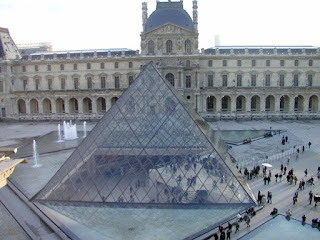
My penultimate day in Paris was spent in the Musée du Louvre. Situated on the Right Bank of the Seine, the Museum is housed in the Louvre Palace, originally a fortress constructed under Philip II during the twelfth-century. Remnants of the fortress are visible in the Museum's basement. The Museum was opened on August 10th, 1793, the majority of the works therein being royal or plundered church property. With a stupefying myriad of treasures among its collections, I resolved to see ten or so objects of personal interest, then explore more broadly, and discover pieces spontaneously. Although I was especially enthusiastic about, among others, Liberty Leading the People (Delacroix), The Coronation of Napoleon (David), Portrait of Baldassare Castiglione (Raphael), and a number of Impressionist works, I knew, in practice, I would be just as taken with entirely new and unexpected discoveries. There would  be invitations to find out more about so many artists with whom I was unfamiliar, as well as welcome opportunities to appreciate anew works I had long admired.   The glass pyramid, completed in 1989, takes visitors into the lobby. If the anticipation was palpable, then evident, too, was the exhaustion of those departing, their experiences in this peerless house of art surely as demanding as they had been inspiring.


I went first, as popular duty required, to the La Giaconde Room, via exquisite classical marbles that adorned the staircase. The space in which Western Art's most notable, if enigmatic, human subject is exhibited, was already swarming. One felt, upon entering, as if they were visiting some holy site, countless pilgrims doing homage to this most celebrated product of the Renaissance Man's imagination. Though its renown and its size are wholly disproportionate - an inestimable reputation against an oaken panel scarcely larger than a broadsheet newspaper - it was, to be sure, something remarkable to observe. "She" who has been identified as, variously, the wife of a Florentine nobleman, as Jesus, and as da Vinci himself, gazes at the viewer from her much-guarded position. The psychology of the smile is as enticing as it is mysterious, purportedly twinning reticence and affability. Somehow, Mona Lisa seems as struck by our attentiveness as we are by hers. If the Cult of Celebrity in which the contemporary is saturated typically centres upon key, identifiable personalities, one wonders if that Obsession, Magnificent and Generational, has its origins in the form of this most elusive figure.


Having always been interested in the political machinations of the Tudor Dynasty, I was keen to see Holbein the Younger's Lady Anna of Cleves (c.1538-9). Seemingly around the same size as the Mona Lisa, the portrait by his court painter persuaded Henry VIII to make the German noblewoman his fourth bride. Their marriage, though, in early 1540, was reportedly never consummated, and annulled after six months. Whatever the licence or integrity of Holbein's representation, Henry felt the reality did not reflect the accounts he had heard. To some extent, one might feel compelled to question Henry's judgement, as there seems nothing innately unattractive in Holbein's image of the twenty-four old, known after her divorce as the "King's Beloved Sister". Although this is not the only surviving portrait of Anne - a canvas of c.1540-45 from the Cologne workshop of Barthel Bruyn the Elder is to be seen in the President's Lodge at St John's College, Oxford, and an after-Holbein engraving of 1739 by Jacobus Houbraken in the National Portrait Gallery - Holbein's is perhaps the most famous, artistry here impacting directly, and ultimately negatively, on complex political circumstances within which Henry sought male succession.


One paradox, I found, about taking the visit in my stride, was that one can move through the galleries in a slightly disorientated manner, astonished at the volume and quantity of what is there, yet to the point of looking but not always truly seeing. Registry of the works almost becomes involuntary, unconscious, if one's attention is not directed specifically at a given piece or pieces. That said, I was struck to find, in the long gallery just off the La Giaconde Room, two remarkable and associated paintings from 1796 by Hubert Robert, Projet d'amenagement de la Grande Galerie du Louvre (Design for the Grand Gallery in the Louvre) and Vue Imaginare de la Grande Galerie en Ruines (Imaginary View of the Grand Gallery of the Louvre in Ruins). Respectively literal and figurative impressions of the hall in which they were displayed, the paintings create a tangible joint impression, blending Enlightenment and decay.

Robert, whose portrait by Louise Élisabeth Vigée Le Brun, generally considered the most famous female painter of the eighteenth-century, can be seen in the Louvre, was born in Paris in May, 1733. After studying at the French Academy in Rome in the 1750s, Robert returned to Paris in 1765, where he became a member of the Académie Royale de peinture et de sculpture. Following Robert's exhibition at the Salon of 1767, he was appointed, successively, Designer of the King's Gardens, Keeper of the King's Pictures, and Keeper of the Museum and Councilor to the Academy. The Salon was the official art exhibition of the Académie des Beaux-Arts, and, from 1748 to 1890, it was the Western world's foremost annual or biennial art event. In Paris, he worked on images in the style of Gabriel de Saint-Aubin (1724-80). He also created views of Paris and of the destruction of houses on the Pont de Neuilly, Pont Notre-Dame and Pont au Change, and the fires at the Opera in 1777 and 1782. In 1784, Charles-Claude Flahaut de la Billaderie, Comte d'Angiviller (1730–1810), effectively a Minister of Fine Arts, appointed Robert a guard of the newly-instituted painting gallery at the Louvre. Robert died in Paris in early 1808.  


Imaginary View was, for me, the most arresting of the two works. The hypothesised appearance of the Grand Gallery following its "destruction" is as romantic as it is barren. The debris resembles the fragmented safeguard of a conservative yet fundamental intellectualism, the cynical dissolution of some traditional place of instruction. Crumbling walls and scattered icons record a disappointed classicism, leaving only the Athenian shell of a once oracular knowledge base. The painting seemingly evokes a muscular liberalism reacting against an artistic elite. An aesthetic canon has been comprehensively eroded, the daylight more invasive than it is incidental - an enclosed Palace of the Mind, however rich, has been stripped away, any creative idealism now answerable to reality, to Nature both benign and unyielding.

Equally, though, if the Imaginary View implies a certain rebellion against established principles, it also laments the decline of that humanistic ethos. On the one hand, the secondary, the created, has been swept away, the referential pulled down in favour of the basic, the innate. Amid the rubble, however, a seated figure, in red and with a flamboyant white collar, sketches the statue before him. The scene tells of chaos, of the removal of an old order, and yet he remains focused on this surviving remnant of apparently antiquated values - its arm is outstretched, as if orating, dictating, commanding attention, still arbitrating how it, the classical emblem par excellence, should and does continue to inspire. Art critic and philosopher Denis Diderot (1713-84) remarked that "The ideas which the ruins awake in me are grand". With such adulation, one can implicitly sympathise - for all the denegration Robert portrays, there is something wonderfully gothic about the scene. Whatever doctrine we see overthrown, there is a peculiar glory in the remains, an unshakeable majesty in the archaic.


As an aside, it is worth noting that probably the closest history has come to fulfilling Robert's vision of the Grand Gallery was in 1939, when Nazi looting of Parisian museums compelled the removal of paintings from the Louvre. They were placed in rural châteaux until the liberation.  


The Design, meanwhile, shows the room in all its richness. Robert deftly conveys the length and depth of the Gallery, detailing distance as acutely as proximity. Those represented in the painting are no mere spectators - they are consumers of art, fully, enthusiastically and confidently engaging with what surrounds them. They are all observers of the Gallery, and each of them students of its content - canvases, porcelain, sculptures, furnishings. Robert celebrates human interaction with art, of how, in its manifold and complex forms, it fuels not purely emotion but a compulsion to act - ensconced in this temple of creative genius, the subjects feel insatiably moved to craft, to articulate afresh, a new and altogether beguiling resonance to individual accomplishment.

Through Robert, we see how art elevates the inanimate to the consequential, silent, inert objects speaking to us with a fundamental and prevailing clarity. In a letter to a friend, Joyce said of Paris "There is an atmosphere of spiritual effort here". It is to this endeavour that Robert shows his characters devoted, a "spiritual" objective revealing artistic production almost to be a moral imperative. We create because we must. In the Louvre, we see represented wonder and horror alike, tones of reality we innately classify as good or ill. Ethical codes arbitrate such distinctions, and duly command our attention. So, too, does any aesthetic that illustrates the contents of those social categories. For Robert's figures, as surely for us, art is not merely a comment on "reality", the secondary innocuously appending the primary, but is itself an incitement to produce, to defer, to critique. Like circumstance and time, and the progress or tragedy necessarily bound within them, art obliges and enables our commitment to posterity the most poetic or abhorrent essentialism.

In the Louvre, we see instinctively, and sometimes reluctantly, just how far actuality and art are synonymous.  


Walking by the Seine early that final evening, I began to appreciate the Louvre's affinity with the City, and our perception of their tantalising interplay. All around us in Paris, there are the realities we accept and the grace we intuit, absorbing both the raw and the ethereal qualities of that haunting place. For its diversity, its temptations, for its sublime contradictions, what could be more natural and more rational than love?


Saturday, 14 January 2012

Love and Tragedy amid the Dreaming Spires


A powerful drama from the Pinter-Losey stable

LIKE The Servant and The Go-Between, Accident (1967) marked an evocative Director-Screenwriter collaboration of Joseph Losey and Harold Pinter. A darkly brilliant portrayal of passion and intellect colliding within the incorrigibly cloistered world of English academe, Accident merges the idyllic escapism of post-war Oxford and a haunting perversion of the Bright Young Things stereotype.

New Zealand teens create alternative world


A morbid collision of fantasy and reality

"There is always a certain madness in love. But also there is always a certain method in madness." - Nietzsche, "Of Reading and Writing", Thus Spoke Zarathustra

WITH Bad Taste and Braindead having confirmed director Peter Jackson as a master of the grotesque, Heavenly Creatures (1994) gave his trademark surrealism a historical grounding. Based on the story of two teenage girls in 1950s New Zealand, whose friendship had tragic consequences, Heavenly Creatures marked the film debuts of Kate Winslet and Melanie Lynskey, and brought Jackson to the attention of a mainstream audience. Far, though, from propagating some lewd apologism of his own for a uniquely callous angst, Jackson instead drew upon a morbidly vivid contemporary source for his inspiration - the schoolgirl journal that itself described the imaginary kingdom Heavenly Creatures brought to the screen. Though a singularly degraded chronicle of otherworldly barbarism, the document fuelled the visual impact of the film, a creativity both exhilarating and unsettling. Nor does Jackson permit aesthetic virtuosity to downplay his implicit condemnation of an act that left an indelible impression on an outwardly sedate community.  Critically acclaimed, the film would garner the Silver Lion at the Venice Film Festival, the Toronto Festival's Metro Media Award, and an Academy Award nomination for Best Original Screenplay, one Jackson wrote collaboratively with wife Frances Walsh.


The murder of 45-year-old Honora Mary Parker in Victoria Park, Christchurch, on June 22nd, 1954, generated a controversy that has never fully abated. Multiple injuries were reported by the coroner, Honora having been struck with a half-brick concealed in a stocking. The two figures responsible for the crime - 16-year-old Pauline Yvonne Parker, Honora's daughter, and her closest friend, 15-year-old Juliet Marion Hulme - were jailed for five years, released on the condition that they would never meet again. Inasmuch as the City's conservative Press arguably founded much of its reporting on supposition rather than fact, Jackson chose to chronicle the girls' friendship that led up to the murder, rather than their trial and detention. Accordingly, Jackson, infamous for the macabre originality of his earlier projects, would now cautiously proportion his new work to the ferocity of an existing account. Allied to Jackson's directorial realisation of that world were the lead performances by two little-known names - from Britain, Kate Winslet, and, from New Zealand, Melanie Lynskey. Their curiously seductive portrayal of the warped protagonists was a revelation, fusing independence and burgeoning intensity in a manner as compelling as it was perverse. The film's script is annotated by Pauline's (Lynskey) diary entries.


Initial moments of scene-setting, a 1950s newsreel of Christchurch, illustrating the visitor attractions of an enchanted suburbia, cut to shots of a blood-spattered Pauline and Juliet (Winslet) running through woodland, shouting hysterically "It's Mummy! She's terribly hurt!" and "Please, help us!" as they reach a kiosk run by Agnes Ritchie (Toni Jones). Such is the tone of the ensuing narrative - the abject schism between an innocuous and a darker reality, propriety and expectation grimly impeded by human nature.

With the action then moving to Christchurch Girls' High School, 1952, and the accompaniment of the school assembly singing "Just a Closer Walk with Thee", we move to Miss Waller's (Elizabeth Moody) French class. The door opens and Miss Stewart (Darien Takle) introduces the newly-arrived Juliet Hulme. Miss Waller invites Juliet to take a seat and to create a French name for herself, according to the tradition of that setting. Barely has she sat down than Juliet points out to Miss Waller that "Je doute qu'il vienne is in fact the spoken subjunctive". Miss Waller is as much taken aback at being corrected as by Juliet's 'name', "Antoinette". Their animated exchange is the first stirring of Juliet's playfully subversive humour. Pauline, seated across the room, is plainly taken with Juliet's carefully-honed challenge to the school's conformist regime.


Juliet's mollification of pain is apparent in her early interactions with Pauline. It emerges that both were sickly children - Juliet spent part of the War afflicted with respiratory illness, while Pauline was also hospitalised, with Osteomyelitis that "....turns your bones to chalk". Juliet enthusiastically asks to see Pauline's scar again, before proudly declaring "All the best people have bad chests and bone diseases. It's all frightfully romantic!". Juliet revels in the mitigation of life's horrors, and, whatever reticence Pauline may feel over such jesting, her arrival at the Hulme residence, Ilam, confirms both her acceptance into Juliet's world and the latter's affluence. Pauline, cycling up the drive, stops suddenly upon reaching the house. The property is as much an announcement as a view, with Juliet acknowledging her from a bridge in the garden. "Oh, hi Paul!" she calls out, resembling a princess, in a magnificent costume, Pauline utterly captivated by the scene. She sees a life markedly different to her own, characterised by liberal aspirations and a social aesthetic that translates the seemingly mythical into reality. Her friend stands, goddess-like, but conveys a geniality that renders Pauline equal rather than subservient.

The montage that follows charts their burgeoning friendship, to the sound of The Donkey Serenade, performed by Mario Lanza, for whom Pauline has inherited a love from Juliet. We see Pauline freed from an anonymous existence at the school and entering into both Juliet's carefree mindset and her family's circle. Pauline studiously observes Mrs Hulme's (Diana Kent) mannerisms at dinner, a formerly shy youngster tutoring herself in the etiquette that seemingly grounds and defines the "lives of others".


Soon, we find Pauline visiting Juliet's house a second time, with the two seated in a candlelit corner of the garden. They cut photographs of James Mason and other film actors from magazines. The spot resembles a shrine, covered with images of the girls' icons. Pauline notes that Mason would be "perfect as Jesus", with Juliet saying she will go not to Heaven but to the "Fourth World". It will be similar to Heaven, she says, "....only better, because there aren't any Christians". Pauline has already seen the reality of Juliet's life - now, she has described a realm of her own invention, portrayed with a quietly anarchic fusion of the secular and the theological. Christians may be excluded from her unorthodox noumena, but the "Saints" will be Mason and Lanza. Elaborating, Juliet calls it "....an absolute Paradise of music, art and pure enjoyment". Her appropriation of a solely hedonistic metaphysics may resemble an attractive ideal, but the cost of her surrogate existence to their mutual reason will soon become horrifically clear.

Juliet meets Pauline's parents, Honora Parker (Sarah Peirse) and Herbert Rieper (Simon O'Connor), for lunch one day in early 1953. "It's so nice to meet you", says Juliet, extending her hand to Pauline's mother. Honora seems almost stifled by the gesture, suggesting not so much her ambivalence in the face of courtesy per se, but certainly her mild inferiority upon witnessing in her young guest such abundant social confidence. During the meal, Juliet describes almost ecstatically how "....Charles, in a blazing fury, runs Lancelot through with his sword, leaving Deborah free to accept Charles' proposal of marriage". Herbert and Honora exchange faintly knowing glances, mutually surprised at Juliet's boundless enthusiasm for quasi-Arthurian tales, and wondering, perhaps, if her vivid imagination and implied estrangement from the everyday is par for the course. The scene partly originates the girls' shared development, in their diaries, of Borovnia, perhaps the land already dubbed the "the Fourth World".


Though the girls' emotional affinity is now confirmed, distinctions between them remain prevalent. Part-way through lunch, Honora shows a border the house, Pauline clearly embarrassed at their implicit need to supplement a purportedly meagre income. Herbert tells Juliet he works at a fish suppliers', with Pauline admitting, almost in exasperation, "he's the manager". One wonders if, for Pauline, an innate attraction of Borovnia is her immersion in a "place" that makes no demands on her true circumstances, one that allows her to create as she pleases, identifying her as a worthy partner in the cultivation of Juliet's beguiling literary invention. Pauline has no need to quantify or explain her situation in a world the content and nature of which she is the joint arbiter.

The evolution of their fantasy world is absolute, consuming and disturbing by turns. Pauline and Juliet are indistinguishable from the character names they assign themselves ("Gina" for Pauline, "Deborah" for Juliet), writing letters to one another while Juliet convalesces from a bout of tuberculosis. Actuality is apparently without meaning in Borovnia, so cocooned are the girls in penning the narratives that bring it to life. Fortresses, unicorns and serene land and seascapes are the aesthetics of this ethereal setting, "Diello" and other characters addressing them by their assumed names. Only too clearly is Borovnia a meritocracy - "Gina's" diary entry for June 7th, 1953 reads "My dearest darling Deborah, Affairs of State continue to occupy my time. I have to report that the lower classes are terrifically dull. Only yesterday, I was compelled to execute several peasants, just to alleviate the boredom". Borovnia is a rhetorical serfdom, validating the mystical language through which "Gina" celebrates the "....miracle that two such heavenly creatures are real". Her assertion that "the outstanding genius of this pair is understood by few" is one of a number of statements illustrating the girls' view of themselves, baseless proclamations that centralise them within a seemingly delusional hierarchy. Pauline, writing from "31 Gloucester Street, Borovnia" merges the real and the hypothetical, tallying with the dual identity she openly adopts for herself. In the eyes of Pauline and Juliet's pseudo-morality, social norms and conventional values are laughable anachronisms, the canonical or universal relegated in favour of Borovnia's chivalric emblems and coarse romanticism.


Upon seeing Juliet and Pauline lying on a bed together at Ilam, Juliet's father, Dr Henry Hulme (Clive Merrison), voices his concerns to Herbert and Honora. Conjecturing that Pauline may be "...developing in a rather - wayward - fashion", he recommends the professional opinion of Dr Bennett (Gilbert Goldie), a physician with some expertise in Child Psychology. "Wayward" is almost certainly Dr Hulme's tacit synonym for "homosexual", the possibility of which is explored in a notably trying exchange between Pauline and Bennett. Dr Bennett suggests Pauline "might like to think about spending more time with boys", Diello suddenly appearing to slice through Bennett with a sword, the camera pulling back to reveal Pauline's triumphant expression upon "witnessing" the dispatch of one who stands in the way of her friendship with Juliet. Imaginary beings do the girls' savage bidding, "executing" all who do not merit inclusion in Borovnia. Fiction now dictates the real, those around Pauline and Juliet fit for life - or only for death - in their gruesomely-maintained elite.

Dr Hulme's plan to leave for England, pending divorce after his wife's affair with a client at the Marriage Guidance Council, and for Juliet to move to South Africa, effectively spells the beginning of the end for her association with Pauline. Despite Herbert and Honora's protestations to the contrary, Mrs Hulme suggests allowing Pauline and Juliet to spend the two weeks before Juliet's departure together. Pauline walks into the hallway at Ilam. Juliet, wearing a ballroom dress, comes down the stairs to greet her. Immediately, the two descend into their fantasy world, dancing to the sound of Mario Lanza singing The Loveliest Night of the Year. The transition from reality to fantasy is seamless, Pauline and Juliet's occupation of both realms adamantly without distinction.


Honora expressly forbids Pauline to join Juliet in South Africa, saying "You're a child. You're fourteen. You belong here, with us". Her mother's defiance of her plans is the lynchpin of the crime, Pauline giving her a look of piercing contempt, with the narration "Suddenly, the means of ridding myself of this obstacle occurred to me. If she were to die....". Pauline sees her mother as little more than an object, an inhibition to her Borovnian existence. A further diary entry, making clear the murder plan, reads "Naturally, we feel a trifle nervous, but the pleasure of anticipation is great. Peculiarly enough, I have no qualms of conscience". Pauline visualises specific actions without assigning them any moral profile or foreseen consequences. Her malevolence is as coolly-engineered as her Borovnian fantasy, those "events" explicitly illustrated but with no ethical framework descriptively intuiting their horror. If Borovnia is without codes of right and wrong, Honora's impending fate is duly sanctioned. Juliet, too, is convinced they have set themselves on a legitimate course - "I think she knows what's going to happen. She doesn't appear to bear us any grudge. Your mother is rather a miserable woman, isn't she", idealising her would-be victim's complicity, with Honora's supposedly colourless personality "validating" their sadism.

The sustained tension of the film's climactic scene is as magnetic as it is chilling. After stopping at a tearoom, a little after 3.00 on the afternoon of June 22nd, Pauline, Juliet and Honora make their way along the tranquil wooded paths of Victoria Park. The benign mood of Puccini's 'Humming Chorus' wilfully sets elegy against anticipation, the choral beauty of the score almost tempting us away from the imminent brutality. The hypnotic quality of the sublime momentarily placates our terrible knowledge. We are certain of an appalling act, but must endure its cold realisation.


Mario Lanza's rendition of You'll Never Walk Alone, at the film's close, laments with conscious irony the end of Pauline and Juliet's friendship without condoning their actions. Their union, underpinned though it was with buoyant imagination and spellbinding tableaux, cannot detract from their evil, Jackson cautious to stress their depravity over the film's visual audacity. Perhaps the standout performances come from Melanie Lynskey and Sarah Peirse, bringing to the screen immaculate portrayals of adolescent rebellion and parental concern. The visual effects, from Weta Digital, are extraordinary, evoking a unique literary and alternative dramatic space.

Harrowing and moving, Heavenly Creatures is an infectious tour de force of New Zealand cinema, deftly balancing shock and taste.