Friday, 20 January 2012

Five days in the City of Light

Wanderings in La Chapelle

MY first visit to Paris in three years, in October, 2009, was to attend a conference on the events of September 11th, the "War on Terror", and the erosion of liberties both in the West and in the Middle East. A guest there was Matthieu Kassovitz, whose La Haine (1995) had seen him awarded the Best Director accolade at the Cannes Film Festival. La Bellevilloise, 19-21 rue Boyer, was among the conference venues.

Originally founded in January, 1877, after the fall of the Commune, Bellevilloise was the first Parisian workers' co-operative built to offer everybody in the capital access to culture and to an awareness of the contemporary political climate. It proved a welcome antidote to a city scarred by recession, and from 1910 to 1949 Bellevilloise played a key role in the social and economic life of Eastern Paris. In 2005, the space was renovated to host media events, arts screenings, and meetings for the surrounding French Moroccan and Algerian community. Now, the venue is an attractively eclectic combination of seminar spaces, discussion rooms and a bar-cafeteria-dance floor area, the latter expressly catered to a young, bohemian clientele. Whatever involved debates may characterise the daily atmosphere at Bellevilloise, the relaxed evening mood made for the ideal backdrop to the conference socialising, participants able to chat in an informal yet absorbing setting. The dining room, the intimate restaurant La Halle aux Oliviers, is populated by olive and palm trees, and is open each Sunday. Served by the Ménilmontant (Line 2) and Gambetta (Line 3) Metro stations, Bellevilloise offers great cuisine and a fantastic selection of cocktails, making for a quietly sophisticated but friendly haunt.


The city, as always, was enchanting, and I was keen to stay in a part through which I had travelled on earlier visits, but had never fully explored, the Boulevard de la Chapelle. Served by Metro station Chapelle, and connected to the Gare du Nord, it marks the border between the capital's 10th and 18th arrondissements.


The elevated line 2 station was opened on January 31st, 1903, as part of the extension of that route from Anvers to Bagnolet, now called Alexandre Dumas. It is named after the Place de la Chapelle, itself derived from the Barrière de la Chapelle, a gate built for the collection of taxation as part of the Wall of the Farmers-General; the gate was built between 1784 and 1788 and demolished after 1859. The gate takes its name from a village annexed by Paris in 1860.


Boulevard de la Chapelle today, a heavily commercial and multicultural area.

I was fascinated to visit, on my first day, at 37 Boulevard de la Chapelle, the Théâtre des Bouffes du Nord. An interior as substantial as it is aesthetic, the auditorium has seating for approximately five hundred. Founded in 1876, the Théâtre had such a troubled beginning that it seemed it may never achieve success as a public arena. In its first decade alone, the Théâtre had fifteen artistic directors, with its most infamous leader, Olga Léaud, absconding with the safe, following a failed production. Looking around me, I sensed this was a place with as dramatic a story to tell as those in the many productions it had staged over some 130 years. Indeed, it was not until the late 1890s that the Théâtre's fortunes genuinely began to improve, under the joint direction of Emmanuel Clot and G. Dublay. Early productions included Dumas' La Reine Margot and Ibsen's An Enemy of the People and The Master Builder. In 1904, the Théâtre was fully refurbished, and renamed Théâtre Molière.


A decade later, though, it was forced to close its doors, like all other Parisian theatres, with the outbreak of war. For the next seventy years, the site would be inhabited by a number of theatre companies, but none of which were able to finance the upkeep of the property.


In 1974, though, Peter Brook made the theatre the home of his own company. After six months' collaborative restoration by Brook and Micheline Rozan, the theatre re-opened on October 15th, with Timon of Athens. One of the comparatively few changes Brook and Rozan made to the performance space was that the stage walls were made bare. It was clear as I looked at the stage how pragmatically inspired that decision was - one could sense palpably just how immediate, naked, the emotion and the action would be against such a skeletal backdrop. The performers would be the centre of attention, and the plain background, far from being unremarkable or anonymous, would be instrumental in conveying the urgency and rich pertinence of the drama.


In 2008, Brook had announced he would hand over to Olivier Mantei, Deputy Head of the Paris Opéra Comique, and to Olivier Poubelle, a theatre entrepeneur specialising in modern music. Brook is seen here at Théâtre des Bouffes du Nord, discussing Hamlet in a new form:

La Chapelle is distinctively multicultural. To the South, one finds shops and businesses run by the local Indian, Pakistani and Sri Lankan population. To the North, the residents are pre-dominantly of Arabian, African, European and Indian origin. A wealth of restaurants, wine bars, clothing and textiles shops annotate the Boulevard, adding to the vibrant cultural tone of the area, with every language and circumstance among the people there. This is not to betray a cruder reality, of course. Barely had I exited the station upon my arrival than a Hungarian lady asked for change, a child in her arms who could not have been more than two years old. If this was the City of Light, then it was also Orwell's Paris, the warts and all survival amid the hedonistic living. I hardly needed reminding that, if the image of the city's infinite vitality is at times more popular than it is objective, then so, too, and inevitably, is the assumption of collective happiness in this hub of outward inspiration. If the Parisian vibe is immutable, then it is little wonder that some must reside on a silent periphery, their world an abject and sobering counter to the otherwise intoxicating, liberating potential.


A commercial and social spectacle, Marché Barbès runs along La Chapelle and Boulevard Roucheouart. This market, I discovered, is a veritable goldmine of cheeses, herbs and spices, fruits, wools, crafts, and freshly-baked African and Middle-Eastern breads. Open Wednesdays and Saturdays, it must surely be one of La Chapelle's most popular attractions, with something to appeal to everybody from the casual onlooker to the keen buyer. One really felt, looking round this market, that they were observing more than just simple purchasing and selling - it was a colourful, energetic interplay of consumers from all over France and from all over the world. There was something infectiously secular about the scene, no one kind of customer to the stalls, no one kind of curiosity excited by the array of goods. Meanwhile, La Chapelle is presently undergoing significant restoration, and appeals especially to those with an active interest in street art.


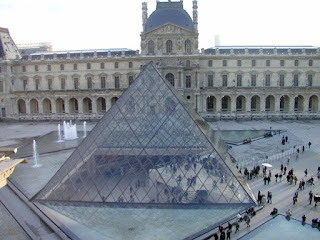
My penultimate day in Paris was spent in the Musée du Louvre. Situated on the Right Bank of the Seine, the Museum is housed in the Louvre Palace, originally a fortress constructed under Philip II during the twelfth-century. Remnants of the fortress are visible in the Museum's basement. The Museum was opened on August 10th, 1793, the majority of the works therein being royal or plundered church property. With a stupefying myriad of treasures among its collections, I resolved to see ten or so objects of personal interest, then explore more broadly, and discover pieces spontaneously. Although I was especially enthusiastic about, among others, Liberty Leading the People (Delacroix), The Coronation of Napoleon (David), Portrait of Baldassare Castiglione (Raphael), and a number of Impressionist works, I knew, in practice, I would be just as taken with entirely new and unexpected discoveries. There would  be invitations to find out more about so many artists with whom I was unfamiliar, as well as welcome opportunities to appreciate anew works I had long admired.   The glass pyramid, completed in 1989, takes visitors into the lobby. If the anticipation was palpable, then evident, too, was the exhaustion of those departing, their experiences in this peerless house of art surely as demanding as they had been inspiring.


I went first, as popular duty required, to the La Giaconde Room, via exquisite classical marbles that adorned the staircase. The space in which Western Art's most notable, if enigmatic, human subject is exhibited, was already swarming. One felt, upon entering, as if they were visiting some holy site, countless pilgrims doing homage to this most celebrated product of the Renaissance Man's imagination. Though its renown and its size are wholly disproportionate - an inestimable reputation against an oaken panel scarcely larger than a broadsheet newspaper - it was, to be sure, something remarkable to observe. "She" who has been identified as, variously, the wife of a Florentine nobleman, as Jesus, and as da Vinci himself, gazes at the viewer from her much-guarded position. The psychology of the smile is as enticing as it is mysterious, purportedly twinning reticence and affability. Somehow, Mona Lisa seems as struck by our attentiveness as we are by hers. If the Cult of Celebrity in which the contemporary is saturated typically centres upon key, identifiable personalities, one wonders if that Obsession, Magnificent and Generational, has its origins in the form of this most elusive figure.


Having always been interested in the political machinations of the Tudor Dynasty, I was keen to see Holbein the Younger's Lady Anna of Cleves (c.1538-9). Seemingly around the same size as the Mona Lisa, the portrait by his court painter persuaded Henry VIII to make the German noblewoman his fourth bride. Their marriage, though, in early 1540, was reportedly never consummated, and annulled after six months. Whatever the licence or integrity of Holbein's representation, Henry felt the reality did not reflect the accounts he had heard. To some extent, one might feel compelled to question Henry's judgement, as there seems nothing innately unattractive in Holbein's image of the twenty-four old, known after her divorce as the "King's Beloved Sister". Although this is not the only surviving portrait of Anne - a canvas of c.1540-45 from the Cologne workshop of Barthel Bruyn the Elder is to be seen in the President's Lodge at St John's College, Oxford, and an after-Holbein engraving of 1739 by Jacobus Houbraken in the National Portrait Gallery - Holbein's is perhaps the most famous, artistry here impacting directly, and ultimately negatively, on complex political circumstances within which Henry sought male succession.


One paradox, I found, about taking the visit in my stride, was that one can move through the galleries in a slightly disorientated manner, astonished at the volume and quantity of what is there, yet to the point of looking but not always truly seeing. Registry of the works almost becomes involuntary, unconscious, if one's attention is not directed specifically at a given piece or pieces. That said, I was struck to find, in the long gallery just off the La Giaconde Room, two remarkable and associated paintings from 1796 by Hubert Robert, Projet d'amenagement de la Grande Galerie du Louvre (Design for the Grand Gallery in the Louvre) and Vue Imaginare de la Grande Galerie en Ruines (Imaginary View of the Grand Gallery of the Louvre in Ruins). Respectively literal and figurative impressions of the hall in which they were displayed, the paintings create a tangible joint impression, blending Enlightenment and decay.

Robert, whose portrait by Louise Élisabeth Vigée Le Brun, generally considered the most famous female painter of the eighteenth-century, can be seen in the Louvre, was born in Paris in May, 1733. After studying at the French Academy in Rome in the 1750s, Robert returned to Paris in 1765, where he became a member of the Académie Royale de peinture et de sculpture. Following Robert's exhibition at the Salon of 1767, he was appointed, successively, Designer of the King's Gardens, Keeper of the King's Pictures, and Keeper of the Museum and Councilor to the Academy. The Salon was the official art exhibition of the Académie des Beaux-Arts, and, from 1748 to 1890, it was the Western world's foremost annual or biennial art event. In Paris, he worked on images in the style of Gabriel de Saint-Aubin (1724-80). He also created views of Paris and of the destruction of houses on the Pont de Neuilly, Pont Notre-Dame and Pont au Change, and the fires at the Opera in 1777 and 1782. In 1784, Charles-Claude Flahaut de la Billaderie, Comte d'Angiviller (1730–1810), effectively a Minister of Fine Arts, appointed Robert a guard of the newly-instituted painting gallery at the Louvre. Robert died in Paris in early 1808.  


Imaginary View was, for me, the most arresting of the two works. The hypothesised appearance of the Grand Gallery following its "destruction" is as romantic as it is barren. The debris resembles the fragmented safeguard of a conservative yet fundamental intellectualism, the cynical dissolution of some traditional place of instruction. Crumbling walls and scattered icons record a disappointed classicism, leaving only the Athenian shell of a once oracular knowledge base. The painting seemingly evokes a muscular liberalism reacting against an artistic elite. An aesthetic canon has been comprehensively eroded, the daylight more invasive than it is incidental - an enclosed Palace of the Mind, however rich, has been stripped away, any creative idealism now answerable to reality, to Nature both benign and unyielding.

Equally, though, if the Imaginary View implies a certain rebellion against established principles, it also laments the decline of that humanistic ethos. On the one hand, the secondary, the created, has been swept away, the referential pulled down in favour of the basic, the innate. Amid the rubble, however, a seated figure, in red and with a flamboyant white collar, sketches the statue before him. The scene tells of chaos, of the removal of an old order, and yet he remains focused on this surviving remnant of apparently antiquated values - its arm is outstretched, as if orating, dictating, commanding attention, still arbitrating how it, the classical emblem par excellence, should and does continue to inspire. Art critic and philosopher Denis Diderot (1713-84) remarked that "The ideas which the ruins awake in me are grand". With such adulation, one can implicitly sympathise - for all the denegration Robert portrays, there is something wonderfully gothic about the scene. Whatever doctrine we see overthrown, there is a peculiar glory in the remains, an unshakeable majesty in the archaic.


As an aside, it is worth noting that probably the closest history has come to fulfilling Robert's vision of the Grand Gallery was in 1939, when Nazi looting of Parisian museums compelled the removal of paintings from the Louvre. They were placed in rural châteaux until the liberation.  


The Design, meanwhile, shows the room in all its richness. Robert deftly conveys the length and depth of the Gallery, detailing distance as acutely as proximity. Those represented in the painting are no mere spectators - they are consumers of art, fully, enthusiastically and confidently engaging with what surrounds them. They are all observers of the Gallery, and each of them students of its content - canvases, porcelain, sculptures, furnishings. Robert celebrates human interaction with art, of how, in its manifold and complex forms, it fuels not purely emotion but a compulsion to act - ensconced in this temple of creative genius, the subjects feel insatiably moved to craft, to articulate afresh, a new and altogether beguiling resonance to individual accomplishment.

Through Robert, we see how art elevates the inanimate to the consequential, silent, inert objects speaking to us with a fundamental and prevailing clarity. In a letter to a friend, Joyce said of Paris "There is an atmosphere of spiritual effort here". It is to this endeavour that Robert shows his characters devoted, a "spiritual" objective revealing artistic production almost to be a moral imperative. We create because we must. In the Louvre, we see represented wonder and horror alike, tones of reality we innately classify as good or ill. Ethical codes arbitrate such distinctions, and duly command our attention. So, too, does any aesthetic that illustrates the contents of those social categories. For Robert's figures, as surely for us, art is not merely a comment on "reality", the secondary innocuously appending the primary, but is itself an incitement to produce, to defer, to critique. Like circumstance and time, and the progress or tragedy necessarily bound within them, art obliges and enables our commitment to posterity the most poetic or abhorrent essentialism.

In the Louvre, we see instinctively, and sometimes reluctantly, just how far actuality and art are synonymous.  


Walking by the Seine early that final evening, I began to appreciate the Louvre's affinity with the City, and our perception of their tantalising interplay. All around us in Paris, there are the realities we accept and the grace we intuit, absorbing both the raw and the ethereal qualities of that haunting place. For its diversity, its temptations, for its sublime contradictions, what could be more natural and more rational than love?


Saturday, 14 January 2012

Love and Tragedy amid the Dreaming Spires


A powerful drama from the Pinter-Losey stable

LIKE The Servant and The Go-Between, Accident (1967) marked an evocative Director-Screenwriter collaboration of Joseph Losey and Harold Pinter. A darkly brilliant portrayal of passion and intellect colliding within the incorrigibly cloistered world of English academe, Accident merges the idyllic escapism of post-war Oxford and a haunting perversion of the Bright Young Things stereotype.

New Zealand teens create alternative world


A morbid collision of fantasy and reality

"There is always a certain madness in love. But also there is always a certain method in madness." - Nietzsche, "Of Reading and Writing", Thus Spoke Zarathustra

WITH Bad Taste and Braindead having confirmed director Peter Jackson as a master of the grotesque, Heavenly Creatures (1994) gave his trademark surrealism a historical grounding. Based on the story of two teenage girls in 1950s New Zealand, whose friendship had tragic consequences, Heavenly Creatures marked the film debuts of Kate Winslet and Melanie Lynskey, and brought Jackson to the attention of a mainstream audience. Far, though, from propagating some lewd apologism of his own for a uniquely callous angst, Jackson instead drew upon a morbidly vivid contemporary source for his inspiration - the schoolgirl journal that itself described the imaginary kingdom Heavenly Creatures brought to the screen. Though a singularly degraded chronicle of otherworldly barbarism, the document fuelled the visual impact of the film, a creativity both exhilarating and unsettling. Nor does Jackson permit aesthetic virtuosity to downplay his implicit condemnation of an act that left an indelible impression on an outwardly sedate community.  Critically acclaimed, the film would garner the Silver Lion at the Venice Film Festival, the Toronto Festival's Metro Media Award, and an Academy Award nomination for Best Original Screenplay, one Jackson wrote collaboratively with wife Frances Walsh.


The murder of 45-year-old Honora Mary Parker in Victoria Park, Christchurch, on June 22nd, 1954, generated a controversy that has never fully abated. Multiple injuries were reported by the coroner, Honora having been struck with a half-brick concealed in a stocking. The two figures responsible for the crime - 16-year-old Pauline Yvonne Parker, Honora's daughter, and her closest friend, 15-year-old Juliet Marion Hulme - were jailed for five years, released on the condition that they would never meet again. Inasmuch as the City's conservative Press arguably founded much of its reporting on supposition rather than fact, Jackson chose to chronicle the girls' friendship that led up to the murder, rather than their trial and detention. Accordingly, Jackson, infamous for the macabre originality of his earlier projects, would now cautiously proportion his new work to the ferocity of an existing account. Allied to Jackson's directorial realisation of that world were the lead performances by two little-known names - from Britain, Kate Winslet, and, from New Zealand, Melanie Lynskey. Their curiously seductive portrayal of the warped protagonists was a revelation, fusing independence and burgeoning intensity in a manner as compelling as it was perverse. The film's script is annotated by Pauline's (Lynskey) diary entries.


Initial moments of scene-setting, a 1950s newsreel of Christchurch, illustrating the visitor attractions of an enchanted suburbia, cut to shots of a blood-spattered Pauline and Juliet (Winslet) running through woodland, shouting hysterically "It's Mummy! She's terribly hurt!" and "Please, help us!" as they reach a kiosk run by Agnes Ritchie (Toni Jones). Such is the tone of the ensuing narrative - the abject schism between an innocuous and a darker reality, propriety and expectation grimly impeded by human nature.

With the action then moving to Christchurch Girls' High School, 1952, and the accompaniment of the school assembly singing "Just a Closer Walk with Thee", we move to Miss Waller's (Elizabeth Moody) French class. The door opens and Miss Stewart (Darien Takle) introduces the newly-arrived Juliet Hulme. Miss Waller invites Juliet to take a seat and to create a French name for herself, according to the tradition of that setting. Barely has she sat down than Juliet points out to Miss Waller that "Je doute qu'il vienne is in fact the spoken subjunctive". Miss Waller is as much taken aback at being corrected as by Juliet's 'name', "Antoinette". Their animated exchange is the first stirring of Juliet's playfully subversive humour. Pauline, seated across the room, is plainly taken with Juliet's carefully-honed challenge to the school's conformist regime.


Juliet's mollification of pain is apparent in her early interactions with Pauline. It emerges that both were sickly children - Juliet spent part of the War afflicted with respiratory illness, while Pauline was also hospitalised, with Osteomyelitis that "....turns your bones to chalk". Juliet enthusiastically asks to see Pauline's scar again, before proudly declaring "All the best people have bad chests and bone diseases. It's all frightfully romantic!". Juliet revels in the mitigation of life's horrors, and, whatever reticence Pauline may feel over such jesting, her arrival at the Hulme residence, Ilam, confirms both her acceptance into Juliet's world and the latter's affluence. Pauline, cycling up the drive, stops suddenly upon reaching the house. The property is as much an announcement as a view, with Juliet acknowledging her from a bridge in the garden. "Oh, hi Paul!" she calls out, resembling a princess, in a magnificent costume, Pauline utterly captivated by the scene. She sees a life markedly different to her own, characterised by liberal aspirations and a social aesthetic that translates the seemingly mythical into reality. Her friend stands, goddess-like, but conveys a geniality that renders Pauline equal rather than subservient.

The montage that follows charts their burgeoning friendship, to the sound of The Donkey Serenade, performed by Mario Lanza, for whom Pauline has inherited a love from Juliet. We see Pauline freed from an anonymous existence at the school and entering into both Juliet's carefree mindset and her family's circle. Pauline studiously observes Mrs Hulme's (Diana Kent) mannerisms at dinner, a formerly shy youngster tutoring herself in the etiquette that seemingly grounds and defines the "lives of others".


Soon, we find Pauline visiting Juliet's house a second time, with the two seated in a candlelit corner of the garden. They cut photographs of James Mason and other film actors from magazines. The spot resembles a shrine, covered with images of the girls' icons. Pauline notes that Mason would be "perfect as Jesus", with Juliet saying she will go not to Heaven but to the "Fourth World". It will be similar to Heaven, she says, "....only better, because there aren't any Christians". Pauline has already seen the reality of Juliet's life - now, she has described a realm of her own invention, portrayed with a quietly anarchic fusion of the secular and the theological. Christians may be excluded from her unorthodox noumena, but the "Saints" will be Mason and Lanza. Elaborating, Juliet calls it "....an absolute Paradise of music, art and pure enjoyment". Her appropriation of a solely hedonistic metaphysics may resemble an attractive ideal, but the cost of her surrogate existence to their mutual reason will soon become horrifically clear.

Juliet meets Pauline's parents, Honora Parker (Sarah Peirse) and Herbert Rieper (Simon O'Connor), for lunch one day in early 1953. "It's so nice to meet you", says Juliet, extending her hand to Pauline's mother. Honora seems almost stifled by the gesture, suggesting not so much her ambivalence in the face of courtesy per se, but certainly her mild inferiority upon witnessing in her young guest such abundant social confidence. During the meal, Juliet describes almost ecstatically how "....Charles, in a blazing fury, runs Lancelot through with his sword, leaving Deborah free to accept Charles' proposal of marriage". Herbert and Honora exchange faintly knowing glances, mutually surprised at Juliet's boundless enthusiasm for quasi-Arthurian tales, and wondering, perhaps, if her vivid imagination and implied estrangement from the everyday is par for the course. The scene partly originates the girls' shared development, in their diaries, of Borovnia, perhaps the land already dubbed the "the Fourth World".


Though the girls' emotional affinity is now confirmed, distinctions between them remain prevalent. Part-way through lunch, Honora shows a border the house, Pauline clearly embarrassed at their implicit need to supplement a purportedly meagre income. Herbert tells Juliet he works at a fish suppliers', with Pauline admitting, almost in exasperation, "he's the manager". One wonders if, for Pauline, an innate attraction of Borovnia is her immersion in a "place" that makes no demands on her true circumstances, one that allows her to create as she pleases, identifying her as a worthy partner in the cultivation of Juliet's beguiling literary invention. Pauline has no need to quantify or explain her situation in a world the content and nature of which she is the joint arbiter.

The evolution of their fantasy world is absolute, consuming and disturbing by turns. Pauline and Juliet are indistinguishable from the character names they assign themselves ("Gina" for Pauline, "Deborah" for Juliet), writing letters to one another while Juliet convalesces from a bout of tuberculosis. Actuality is apparently without meaning in Borovnia, so cocooned are the girls in penning the narratives that bring it to life. Fortresses, unicorns and serene land and seascapes are the aesthetics of this ethereal setting, "Diello" and other characters addressing them by their assumed names. Only too clearly is Borovnia a meritocracy - "Gina's" diary entry for June 7th, 1953 reads "My dearest darling Deborah, Affairs of State continue to occupy my time. I have to report that the lower classes are terrifically dull. Only yesterday, I was compelled to execute several peasants, just to alleviate the boredom". Borovnia is a rhetorical serfdom, validating the mystical language through which "Gina" celebrates the "....miracle that two such heavenly creatures are real". Her assertion that "the outstanding genius of this pair is understood by few" is one of a number of statements illustrating the girls' view of themselves, baseless proclamations that centralise them within a seemingly delusional hierarchy. Pauline, writing from "31 Gloucester Street, Borovnia" merges the real and the hypothetical, tallying with the dual identity she openly adopts for herself. In the eyes of Pauline and Juliet's pseudo-morality, social norms and conventional values are laughable anachronisms, the canonical or universal relegated in favour of Borovnia's chivalric emblems and coarse romanticism.


Upon seeing Juliet and Pauline lying on a bed together at Ilam, Juliet's father, Dr Henry Hulme (Clive Merrison), voices his concerns to Herbert and Honora. Conjecturing that Pauline may be "...developing in a rather - wayward - fashion", he recommends the professional opinion of Dr Bennett (Gilbert Goldie), a physician with some expertise in Child Psychology. "Wayward" is almost certainly Dr Hulme's tacit synonym for "homosexual", the possibility of which is explored in a notably trying exchange between Pauline and Bennett. Dr Bennett suggests Pauline "might like to think about spending more time with boys", Diello suddenly appearing to slice through Bennett with a sword, the camera pulling back to reveal Pauline's triumphant expression upon "witnessing" the dispatch of one who stands in the way of her friendship with Juliet. Imaginary beings do the girls' savage bidding, "executing" all who do not merit inclusion in Borovnia. Fiction now dictates the real, those around Pauline and Juliet fit for life - or only for death - in their gruesomely-maintained elite.

Dr Hulme's plan to leave for England, pending divorce after his wife's affair with a client at the Marriage Guidance Council, and for Juliet to move to South Africa, effectively spells the beginning of the end for her association with Pauline. Despite Herbert and Honora's protestations to the contrary, Mrs Hulme suggests allowing Pauline and Juliet to spend the two weeks before Juliet's departure together. Pauline walks into the hallway at Ilam. Juliet, wearing a ballroom dress, comes down the stairs to greet her. Immediately, the two descend into their fantasy world, dancing to the sound of Mario Lanza singing The Loveliest Night of the Year. The transition from reality to fantasy is seamless, Pauline and Juliet's occupation of both realms adamantly without distinction.


Honora expressly forbids Pauline to join Juliet in South Africa, saying "You're a child. You're fourteen. You belong here, with us". Her mother's defiance of her plans is the lynchpin of the crime, Pauline giving her a look of piercing contempt, with the narration "Suddenly, the means of ridding myself of this obstacle occurred to me. If she were to die....". Pauline sees her mother as little more than an object, an inhibition to her Borovnian existence. A further diary entry, making clear the murder plan, reads "Naturally, we feel a trifle nervous, but the pleasure of anticipation is great. Peculiarly enough, I have no qualms of conscience". Pauline visualises specific actions without assigning them any moral profile or foreseen consequences. Her malevolence is as coolly-engineered as her Borovnian fantasy, those "events" explicitly illustrated but with no ethical framework descriptively intuiting their horror. If Borovnia is without codes of right and wrong, Honora's impending fate is duly sanctioned. Juliet, too, is convinced they have set themselves on a legitimate course - "I think she knows what's going to happen. She doesn't appear to bear us any grudge. Your mother is rather a miserable woman, isn't she", idealising her would-be victim's complicity, with Honora's supposedly colourless personality "validating" their sadism.

The sustained tension of the film's climactic scene is as magnetic as it is chilling. After stopping at a tearoom, a little after 3.00 on the afternoon of June 22nd, Pauline, Juliet and Honora make their way along the tranquil wooded paths of Victoria Park. The benign mood of Puccini's 'Humming Chorus' wilfully sets elegy against anticipation, the choral beauty of the score almost tempting us away from the imminent brutality. The hypnotic quality of the sublime momentarily placates our terrible knowledge. We are certain of an appalling act, but must endure its cold realisation.


Mario Lanza's rendition of You'll Never Walk Alone, at the film's close, laments with conscious irony the end of Pauline and Juliet's friendship without condoning their actions. Their union, underpinned though it was with buoyant imagination and spellbinding tableaux, cannot detract from their evil, Jackson cautious to stress their depravity over the film's visual audacity. Perhaps the standout performances come from Melanie Lynskey and Sarah Peirse, bringing to the screen immaculate portrayals of adolescent rebellion and parental concern. The visual effects, from Weta Digital, are extraordinary, evoking a unique literary and alternative dramatic space.

Harrowing and moving, Heavenly Creatures is an infectious tour de force of New Zealand cinema, deftly balancing shock and taste. 

Friday, 30 December 2011

Typical Resonance from Salford Genius


The Sociology and the Artistry

IN the holdings of the Fitzwilliam Museum, Cambridge, is to be found L.S. Lowry's After the Wedding (1939), revealing as much about ideology as happiness.

The characters of the title occasion are both prominent and obscure. They stand in the distance, on the chapel steps, dwarfed by buildings left and right, yet are the centre of the crowd's attention. For the couple, this is a uniquely significant day, yet Lowry shows the business of life continuing amid the more placid business of etiquette. In the background, factory towers and church spires stand side by side, the men of steel and the men of God seemingly competing for ideological supremacy. Amid all the occasion, the axis of industry is ever turning, chimneys emitting a blackness as foreboding as it is evocative.

Key to the drama the bride and groom undoubtedly are, we find, as so often with Lowry, that everybody is a character. The adults and the children, the old and young, are members of his artistic democracy, nobody given pride of place amid the beguilingly individual appearances and idiosyncrasies.

The Transience of Life: Two Canvases from the Ashmolean

Quietly Remarkable Pieces in the Baroque Tradition

From rest and sleepe, which but thy pictures bee,
Much pleasure; then from thee much more must flow,
And soonest our best men with thee doe goe...

- John Donne, 'Death, be not proud', Holy Sonnet X

AMONG the Baroque treasures in the Ashmolean Museum, Oxford, are two deceptively simple paintings, Portrait of a Young Man with a Skull, an early work of Bernardino Licinio, and An Allegory of Vanity, Showing Truth Personified by a Young Woman Holding a Pair of Scales and a Mirror, by an unknown artist. Though both comparatively small canvases, they offer telling perspectives on finitude, melancholic ruminations on both the primitivism and the inevitability of death.

Portrait of a Young Man with a Skull (Bernardino Licinio)


Born in Bergamo, North East of Milan, Bernardino Licinio (c.1489-c.1565) worked in Lombardy and the city in which his Portrait was probably completed, Venice. Dating from around 1515, it was one of six paintings bequeathed to the Ashmolean by Gaspard Farrer, ones he inherited from his father, Sir William Farrer, one of the nineteenth century's foremost collectors of Italian art.

The combination of man and skull reminds us innately of the Danish Prince, the sitter's expression characteristic of one for whom pained meditation is more a vocation than a tendency. The man looks into the distance, a gaze that is intense, almost defiant, yet wearied in its curious resignation. His hands are loose, vacant - he seems more the custodian of the skull than the possessor. He holds it not so much as some coveted relic of humanity as a libation to be offered to an unseen recipient. The collision of youthful vitality and the naked immutability of death could not be more abject, and yet Licinio associates rather than distinguishes the man and the object - respectively, they are the first and final stages of the universal passage from becoming to inertia.

Far from idealising the man's vigour, Licinio shows him in black garb. His attire is as gaunt as the skull, Licinio aligning life and death rather than intrinsically venerating existence over fate. There is no fusion here of death and horror, nor any synonym of existence and virtue, as if life is implicitly to be exalted and death naturally shunned. With the skull motif, the metaphysical denotes immediacy rather than abstraction. It functions not as the emblem of some popularly-perceived esoterica, but as Licinio's lyrical yet blunt twinning of perception and negation. It recalls a former identity, a past capacity for happiness and aspiration, thought and reason. If the man's gestures echo Hamlet's doleful musings, then they resonate, too, with Edgar's enforced humility. "That's something yet...I nothing am" (3.2.21) says Lear's godson, reducing himself to utter anonymity. Edgar's denial of his own identity recalls, in Licinio's canvas, the man's affinity with nothingness, conveying a sobriety tantamount to deprivation. If Edgar's relegation of Self likens him to a mere object, then "something yet" is how Licinio has the man view the skull. It typifies nothingness and thus something - it is the shell of a unique agency, a remnant of fundamental personhood. In the closing speech, Edgar is still more submissive, observing "The oldest hath borne most; we that are young, shall never see so much, nor live so long" (5.3.326-8). He concedes the limitations of youth and the salience of experience. Even as he stands surrounded by death, Edgar preserves the example and character of those who have gone before. As in Licinio's vision, mortality is neither to be feared nor scorned as the antithesis of some precious social aesthetic, but accepted and laid bare. If we are not spared Licinio's artistic candour, then nor are we his creative integrity.

An Allegory of Vanity, Showing Truth Personified by a Young Woman Holding a Pair of Scales and a Mirror (Artist Unknown)


The woman denotes and fulfils both elements of the Dane's aspirant epistemology, "...to hold, as 'twere, the mirror up to nature..." (III.II.21-22) and "...I could be bounded in a nutshell and count myself a king of infinite space..." (II.II.254-55). Hamlet advocates a futile objective - the containment of reality within a defined frame, and yet Phenomena is too vast, nuanced, for pedestrian reflection and apprehension. Further, he wills his arbitration of an unbounded realm from a confine, a quasi-divinity with pretensions to quantifying Noumena according to some idealised criteria.

The woman holds up a set of scales, presuming to weigh up life, as if existence is at her dictation. In the scales, life is measured quantitatively rather than qualitatively, a false reckoning over innate recognition of its value. The woman stands "above" the skull, apparently taking precedence over, and neglecting, the individual's former agency. Amid her sumptuous garb, she reduces the skull purely to an inanimate object, rather than a relic that once housed a unique seat of reason and emotion, conscience and insight. Equally, though, for all the woman's treatment of the skull as a mere footnote to her beauty, she also portrays it in the most conspicuous and negative light. She reflects it in the mirror, showing us the skull from different angles. The woman advertises the fact of death, and does so with a purse-lipped, almost arrogant sincerity. She presents the skull as if indicting death, as though mortality were a vice to see embarrassed, even shamed.

The positioning of the skull atop the folio reduces what was once the place of that faculty which enabled perception and registered experience to links purely with theory and hypothesis. The textual may feed the imagination and offer salient instruction, but, here, the woman, in her colour-rich attire, takes centre stage while that other "subject" is aligned to the scholarly but not the pragmatic, the inspirational but not the aesthetic. Vanity cajoles us into exclusively visual considerations, motioning the eye to her appearance rather than the curious pathos of that Other "character".  


Tuesday, 27 December 2011

The Nine Days' Queen: A Victim of Tragic Ambition


Politics and Power Play in Tudor England

IT was in 1985, just as his Artistic Direction of the RSC was drawing to a close, that Trevor Nunn made his first film in a decade, historical drama Lady Jane. Helena Bonham-Carter, fresh from her breakthrough appearance as Lucy Honeychurch in Merchant-Ivory's acclaimed A Room with a View, took the title role, opposite Cary Elwes as Guildford Dudley.

To what extent the marriage, in early 1553, of Lady Jane Grey and Guildford Dudley, was politically motivated, remains unclear. What is significant, though, is that shortly before his death the same year, Edward VI signed a document, "My devise for the Succession", effectively enabling Grey to succeed him.  How much John Dudley, 1st Duke of Northumberland, leader of Edward's government, influenced the King's revision of that legislation, is debated. What the film makes clear, however, is that the union of Dudley's son with the eldest daughter of the Suffolk dynasty would impede a Catholic succession and cultivate Jane's otherwise tenuous claim to the throne.  


The film opens with the execution, in 1552, of Edward Seymour, Duke of Somerset, England's Lord Protector, and the elevation to that role of John Dudley (John Wood). The drama moves to a hunting party for the Suffolk household, and our introduction to Lady Jane. She is seated by a window, reading, when Princess Mary's Confessor, Dr Feckenham (Michael Hordern), enters, surprised to find her not participating in her family's "sport". By virtue of her impeccable humanist education, Jane was known as one of the most learned women of her day, and the exchange with Feckenham recalls her meeting in 1549 with scholar Roger Ascham. In The Scholemaster (1570), Ascham described their encounter at Bradgate Park, Leicestershire, her probable birthplace: "I found her in her chamber, reading Phaedo Platonis in Greek, and that with as much pleasure as some gentlemen would read a merry tale in Boccaccio". Jane's debate with Feckenham on the death of Socrates, and the allied notion of sacrifice, prefaces one of the film's key themes - her desire not for power but for freedom to pursue contemplative study, diametrically opposing her to her parents' insatiable appetite for elevation, ambitions at the centre of which they, in collusion with Dudley, manipulatively place their daughter.


We see Jane immersed in two very different worlds. The first is that of her parents, Henry Grey, Duke of Suffolk (Patrick Stewart) and Frances Grey, Duchess of Suffolk (Sara Kestelman), for whom she is seemingly little more than a pawn in their intricate yet dangerous bid for greater political influence. The second is her relationship with Dr Feckenham, who finds in Jane, amid the "many things on which [we] will disagree", a precociously brilliant mentee, and perhaps an intellectual equal. The Platonic sentiment voiced in that first, classically-grounded interaction, "the soul takes flight to the world that is invisible, and there arriving she is sure of bliss", though ostensibly intimating the protagonist's eventual fate, touchingly marks their association throughout. Theirs is an affinity underscored by an emotive metaphysics that always places true feeling ahead of mutual inquisitiveness.

Implicit, though, is Jane's positioning at centre stage in egocentric manoeuvrings of which she wants no part. So blinded are her parents by the social potential of a Suffolk-Northumberland match that her mother birches her as much for disappointing their plans as for her admirable reticence over the union. The early stages of their marriage are fraught. Guildford's friend Thomas (Pip Torrens) can do little to thwart the young Dudley's drinking, and a fracas between the couple and a group of beggars en route to the estate where they spend their first days together leads to an argument that exposes Jane's distance from the realities of life. She describes the man who confronted them on the road (Clyde Pollitt) as "marked" rather than "branded", not understanding how he may have fallen into poverty. Expressing his angry social conscience, Guildford lays the blame at the door of "Your father and my father, and men like them", and their "principle" of making desperation a sin. For Dr Feckenham and for King Edward, Jane's learning is "an example to us all". To Guildford, it simply explains Jane's ignorance, more concerned as she apparently is with ancient thought than with the raw fluidity of the everyday.


Guildford's later apology, though, and their first night together, successively mark the end of Jane's innocence and the beginning of their romance. In the parlour, with Jane having related to a group of expected guests that she and Guildford are "unwell", the couple are left alone. He challenges her to say what, if she could have anything, her choice would be. Remarking that she would will "...our country to remain true to the faith of God as revealed to us in Scripture", Guildford then takes a goblet of red wine and smashes it on the floor, declaring "then it's done". Cue a series of alternating ideals, from an end to slavery to compassion for the young, via the "death of all bishops, cardinals and popes". Each broken glass spills the sacred lifeblood of a given injustice that annotates the "moral" and religious social condition of the day. Theirs is a hypothetical liberalism that would chasten elites and foster collective humility.   

None of this, though, can dissuade Northumberland's ruthless machinations, with Jane's "coronation" designed as much to assert the Duke's authority as hers, one he has deftly coaxed from slight to that which, if defied, would see any contrarian be judged "a traitor". For Jane, the spectacle is intolerable, with her eventually urging Guildford to "take me out of here", this prison of arranged hierarchy. So bound up in the theatre of the moment are Dudley, the courtiers, and Jane's parents, that she alone recognises the absurdity of the scene and the political truth that "this is not [my] right". Though faced with a crown she expressly does not want, Jane, with Guildford, is at least now free to enact the laws that inspire them most. At the first meeting of what she calls "Our Council", attended by both Northumberland and her father, her advisers exchange wearied glances, seemingly amused by what they regard as the sentimental fantasy of Jane's policies. Proposals to repeal branding, to return lands taken up during the Reformation to the common people, and the institution of a school to instruct children through patience rather than beatings, are met with thinly-veiled scorn. Her Council acknowledge her "God Given Power", so long as it accords with their superficial image of "progress".


The divisions within Jane's power base effectively signal the beginning of the end of Northumberland's magnificent but destructive obsession. The Spanish Ambassador, Renard (Lee Montague), makes clear to Mary I (Jane Lapotaire) that she may only marry Philip of Spain if "Jane Grey and her husband both die". Only through their removal can the threat be entirely erased. This insistence, and an insurrection led by Henry Grey, culminate in Guildford and Jane's indictment and confinement to the Tower. Dr Feckenham's final meeting with Jane, in which his account of her husband's death is interspersed with the image of her own, is powerfully moving. We are reminded that, whatever the conspiracies into which others have placed Jane, his belief in the strength of her convictions was ever genuine and intractably firm. In Lady Jane, it is not Mary's power that prevails, but the protégé of one who nurtured rather than dictated that silent but transcendent intellect. Through his words, the film's closing line, a unique figure is raised up to that Place overseen by One in whose service Jane's sole aspiration was to place herself.  

Though the film's depiction of Jane and Guildford's romance may necessarily owe more to artistic licence than to fact - history alleges, variously, that the couple either disliked one another or spent little time together - its image of the child prodigy seems strongly to reflect contemporary testimony. In mirroring A.F. Pollard's assessment of Jane, in The History of England (1911), as the "traitor-heroine of the Reformation", it shows clearly that events gave Jane's life its drama, but her modest brilliance its distinction. The contradiction and violence of her story muted so much of its potential, but what resonates most vividly is the outlook that always put quiet but assured principle over moral triumphalism.


An impeccably-acted drama, by Bonham-Carter, Elwes and Hordern, especially.  Lady Jane is richly complemented by Nunn's intelligent direction and an evocative score from Stephen Oliver. 

Wednesday, 21 December 2011

Is Nietzsche's 'On Truth and Lies in a Non-Moral Sense' a Work of Fiction or a Work of Philosophy?


Is Nietzsche's 'On Truth and Lies in a Non-Moral Sense'
a Work of Fiction or a Work of Philosophy?

Paper given at the Ivory Tower Society, Pembroke College, Cambridge
Lent Term 2012

ABSTRACT: Initially unpublished, Nietzsche’s ‘On Truth and Lies in a Non-Moral Sense’ (Über Wahrheit und Lüge im außermoralischen Sinn) (1) is an essay of arresting evaluative and literary power. Therein, Nietzsche argues that “Truths are illusions we have forgotten are illusions”, his doleful contention that Man creates fantasies to substitute unpalatable aspects of his existence, consciously obscuring his true circumstances beneath a veil of false desires and precarious ideals. This article, discussing the stylistic and generic nuances of Nietzsche’s discourse, examines whether it is ultimately a work of fiction or of philosophy. In considering that interdisciplinary question, I focus upon a range of Classical and Early Modern texts – philosophical, poetic, dramatic, political, and psychoanalytical - to annotate Nietzsche’s exposé of humanity’s propensity for myth-making in the name of a romanticised rather than objective empiricism.

~

This above all: to thine own self be true…
                                                                        - Polonius, Hamlet (1.3.78) (1905:875)

Introduction: Locating ‘On Truth and Lies’ Chronologically and Ideologically

Hume, like Nietzsche, published his first major work, A Treatise of Human Nature, at the age of twenty-eight, and, just as Hume followed his seminal debut with the Essays Moral and Political, Nietzsche devoted his energies immediately after The Birth of Tragedy to a series of discourses, the Untimely Meditations. Outside of their scope, though, fell a work initially unpublished, ‘On Truth and Lies in a Non-Moral Sense’ (1873), sometimes called ‘On Truth and Lies in an Extra-Moral Sense’. At the heart of that work is Nietzsche’s declaration that “Truths are illusions we have forgotten are illusions”, whereby humanity wilfully contorts or subdues the unpalatable tenets of existence with deftly-engineered falsehoods. Angrily mimicking, if necessarily so, at the beginning of his parable, Man’s view of himself as the measure of all things, it is precisely within this projected intellectual pride that Nietzsche situates the nub of his polemic – to illuminate not only the epistemic vanity that convinces Man there is nothing beyond the remit of his mind and comprehension, but the arrogance that abounds in his ‘selection’ of what he tolerates or rejects. Not merely does Man hold all things to be within the scope of his imagination or understanding, he also presumes to evade what he views as threatening or repugnant, if and when it does not conform to his neat ideal of what is, or of how circumstances should preferably unfold. For Nietzsche, Man’s cardinal hypocrisy is not his veneration of perception, but to qualitatively arbitrate those intuitions – the attractive confidently and inevitably pursued, the ‘vulgar’ scorned and flatly dismissed.

Far, though, from constituting some isolated, “stand alone” piece, ‘OTALIAN-MS’ presages certain strands of Nietzsche’s later thinking, as we will see in extracts from Human, All Too Human, The Gay Science and Beyond Good and Evil. I use the term ‘strands’ here advisedly, then, inasmuch as Nietzsche’s oeuvre seemingly promotes no explicit, defined system, with his essay circumstantially enamouring itself to passages in his mature writings rather than consciously setting the agenda of that later scholarship. It is precisely the absence within his philosophy of a steadfast doctrine, though, that permits, here, an interdisciplinary study of Nietzsche’s critique of Man’s wilful recourse to illusion, revealing both that cynicism in the developed Nietzsche, and how, with ‘OTALIAN-MS’ as our textual basis, other authors have expressed similarly critical and cautionary sentiments. Thus, it is the objective of this paper to examine how questions of perennial interest to philosophers – particularly truth, knowledge and reality - are treated in a compelling example of Nietzsche’s juvenilia, how it may best be classified, and how it annotates or anticipates certain of his and others’ perspectives on dogmatic humanism. It is hoped that the following evaluation will offer a fresh angle on a notable, yet arguably underappreciated, piece by a young Nietzsche.


‘Non-Moral’ Truths and Lies: Quasi Truths, Genuine Falsehoods

What is at once distinctive about Nietzsche’s essay is the markedly paradoxical quality of its title. Imagining truth as ‘non-moral’ illustrates human tendencies to create ‘truths’, and the way in which we ‘design’ them, so as to satisfy a certain motive, need or desire. A ‘non-moral’ account of truth suggests our capacity to sacrilegiously caricature ‘purer’, ‘universally acceptable’ definitions of truth in a bid to fulfil a specific purpose. Perhaps, here, Nietzsche claims that our versions or interpretations of truth are solely ‘divisions’ or ‘types’ of “genuine truths”, those concepts we mentally construct and subsequently urge ourselves to value as “actual truths”.

                        Convictions are more dangerous enemies of truth than lies
                                                                                                            (1994:274)

remarked Nietzsche in HH (1878) – reinforcing his argument presented in ‘OTALIAN-MS’, Nietzsche demonstrates the way in which humans can, if they will themselves to, come to emphatically believe in the validity of their self-made ‘classifications’ of truth.

Additional to this, then, while Nietzsche seems to suggest that (in our own minds) lies cannot always be seen as entirely immoral, perhaps the same can be said for truth – if we have ulterior motives for permitting lies to masquerade as truths, are there situations or instances – irrespective of whether they are of our own making, or to what end – in which the absolute morality of truth can itself be disputed?
           
Nietzsche, in his title, seems to place these concepts – “Truth and Lies…” (my emphasis) – into the same ‘category’, isolating them from “…In a Non-Moral Sense”. Perhaps Nietzsche is here suggesting something of what his own style will be – one that may be controversial, not entirely moral, and therefore (possibly) in defiance of ‘conventional’ or ‘traditional’ writing tones. His title is enigmatic, and indicates little to the reader in terms of what his themes and arguments will be, and how they will be expressed and structured.

A Nietzschian Fairy Tale: Fantasies Benign and Crude

The indication that Nietzsche’s essay may be a work of fiction is something of which the reader is immediately conscious. “Once upon a time” is a phrase with which we are all familiar. A typical opening to a fairy tale, our acknowledgement of these words is intuitive, through our recognition of its literary and cultural associations. It is a ‘term’ that has now transcended a ‘tone’ or ‘feeling’, and instead presents itself as linguistically indicative of a specific genre.

Nietzsche follows his opening with a reflection on the Creation. Like so much of the opening section to this piece, there is a patently fantastical feel to his words -

                        …in some out of the way corner of that universe which is dispersed
                        into numberless twinkling solar systems, there was a star upon which
                        the clever beasts invented knowing.

The lyrical description of the universe and its beginnings emphasises the ‘fictional’ quality of this piece – ‘beasts’ are the ‘characters’ of fairy tales, and the way in which he describes the cosmos reflects the conventions characteristic of creative fiction.

He calls the point at which
                        …the clever beasts invented knowing…the most arrogant and
                        mendacious minute of world history.

Here, Nietzsche amplifies the absurdity of such an idea – as if ‘knowing’ can be invented, or spoken about in terms of something which can be seen or touched. Nietzsche comments on the necessarily logical progress of time – (a) the world, at this point, has barely aged enough to be thought of as having had a substantial ‘history’ (that is, of possessing a consequential past), and (b) Nietzsche again indicates how premature, how excessive, the beasts are in their belief that they have already significantly influenced the ‘evolution of time’.

Nietzsche describes how
                        …the clever beasts had to die.

From a fictional – in this instance, literary – point of view, perhaps the foremost illustration of this principle (the governance of one’s destiny) is present in Oedipus Rex. Though Oedipus has, as the Chorus acknowledges at the climax of the tragedy
                        …solved the…riddle [of the sphinx] with his brilliance,
                                                                                                (1984:251, l.1679)

their words very much symbolize the attitude, and subsequent end, of Nietzsche’s beasts. The beasts, certain of supremacy and a kind of ‘eternal iconography’ or ‘ongoing renown’, must themselves submit to the reality of finite power. Freud, writing in The Interpretation of Dreams, dubbed the Sophoclean drama
                        …a tragedy of destiny.
                                                            (1991:363)

Perhaps the same can be said for the beasts – they are, through extreme complacency, responsible for their own undoing, Freud’s definition embodying their inevitable demise. Elsewhere in fiction, we see this theme – relentless, overwhelming self-confidence in our abilities and freedom to dictate the future, faith in our knowledge, and the consequences of such thoughts – at work in, for instance, King Lear, Washington Square, and, from a more scientific standpoint, Frankenstein.

Nietzsche employs the ‘beasts’ metaphor at other points in his work. In “On the Use and Abuse of History for Life”, in UM, Nietzsche echoes the language and ideas we have discussed –

                        Then he says, ‘I remember…’ and envies the beast that forgets
                        at once and sees every moment really die, sink into night and mist,
                        extinguished forever. The beast lives unhistorically: for it “goes
                        into” the present, like a number, without leaving any curious
                        remainder.
                                                                                                (1997: 106)

Here, then, Nietzsche develops his ideas presented in ‘OTALIAN-MS’ – whatever it may be that the beasts have achieved, or created, it will only be remembered for a time. Recalling Creon’s pronouncement on the King of Thebes,

                        None of [their] power will follow [them] through life
                                                                                                (1984:250, l.1677)

and there will be no evidence of their having existed. Aristotle holds in The Politics (12.53a) that

                        He who is unable to live in society, or who has no need because
                        he is sufficient for himself, must be either a beast or a god.
                                                                                                (1962:60)

Aristotle’s beasts, thinking of themselves as “gods”, believe they have no role or purpose in this society, which will consequently be reluctant to accommodate anything or anyone which or whom considers it or themselves superior to, or irrationally feels threatened by, other beings in that environment.

Nietzsche continues –
                        One might invent such a fable, and yet he still would not have    
                        adequately illustrated how miserable, how shadowy and transient,
                        how aimless and arbitrary the human intellect looks within nature.

Here, Nietzsche, speaking in characteristically pessimistic language, comments on how unremarkable, how insignificant, the mind seems in comparison to the incalculable enormity of nature. His reference to his examination of the beasts as a kind of ‘fable’ seems reminiscent of his claim at the opening of BGE (1886) that he has

                        …gradually come to understand what every great philosophy until now
                        has been: the confession of its author and a kind of involuntary, unconscious
                        memoir.             
                                                                                                                 (1973:37)
           
Nietzsche tempers and rationalises his doctrine, representing his thoughts as subordinate to a broader, impersonal system of values.

He has made, then, a stylistic admission about what he has said in ‘OTALIAN-MS’ – it is a ‘fable’, a fiction he has created as a device to promote a certain argument, which nevertheless speaks to us in the form of a ‘story’. He concedes the “inadequacy” of fables as a tool for voicing his claims regarding the intellect – in any bid to illustrate the shallowness of the mind, this breed of literature is insufficient and inappropriate, as it tends towards the creative, whereas philosophy provides the evaluative apparatus that facilitates analysis rather than mere description.

For Nietzsche, it seems humans are comparable to the beasts – gaining all knowledge, or living in pursuit of all knowledge, is not in our best interests. Ever knowing all that we may want to about Nature is an insurmountable feat, and it is surely best – or rather, inevitable – that the intellect should remain uncertain about some things, if some questions cannot be answered and all problems solved.

Thus, the tragedy of the beasts is not death but the mortality of the intellect – all that desires, articulates and perceives must submit to eventual fate. The capacities and virtues of “humanism” are finite, the cessation of the mind according with that of the body. In contemplating the end of the beasts, Nietzsche laments their unfulfilled aim, and, more significantly, the pathos of their endeavours – a futile commitment to acquiring all knowledge, efforts that prologue nothing.

                        …when it is all over with the intellect…,
says Nietzsche,
                        …nothing will have happened.

Void “envelopes” and displaces the intellect, leaving no firm, indelible testament to all that it has accomplished. It was not, by ‘design’, intended to serve any purpose after humanity.

As he progresses, Nietzsche again indicates something of his themes and beliefs in this piece-

                        …the proudest of men, the philosopher, supposes that on all sides
                        the eyes of the universe telescopically focused upon his action and
                        thought.

Nature Contra Man: Cartesian and Nietzschian Perspectives

Nietzsche returns to an issue raised previously, and one he will continue to revisit – the belief of individual humans that the attention and concerns of all others may be focused directly, and exclusively, on their thoughts and ideas, fears and hopes. Nietzsche calls the philosopher
                        …the proudest of men…,

suggesting the way a thinker may view himself, and his role – a ‘master of thought’, who cannot see through his perception of himself as a being who was made to find answers to all things. He is ‘proud’, in awe of his belief that he holds a key to all unsolved questions and problems, and is convinced that others have absolute faith in his god-like ability or power to do this.

By extension, then, the philosopher, through Nietzsche, is represented as a figure who does not fully understand the purpose of Philosophy itself – not a subject, or movement, motivated towards finding definitive answers, but a discipline content to entertain differing theories, ideas and viewpoints, in the hope of shedding new light on critical questions.

Nietzsche continues his commentary on the ‘role’ of the intellect. He claims it is ‘remarkable’ that all he has said was the product, or result, of the intellect. He claims that the principal purpose of the intellect was to allow the beasts a ‘minute’ of existence – instead, it is the intellect, or rather, the beasts’ belief in their intellect, that has governed their destiny. Presenting a human comparison, Nietzsche claims that the intellect operated in the same way – that is, making existence possible – for ‘Lessing’s Son’. (2)

It is from here that Nietzsche lays the foundations for the argumentative core of his essay, a form of ‘accusation’ he ‘brings against humanity’ -
                        Deception, flattering, lying, deluding, talking behind the back, putting
                        up a false front, living in borrowed splendour, wearing a mask, hiding
                        behind convention.

Nietzsche, as he has implied, sees individual persons as continually living behind a façade and it is not until they pause and reflect on their attitudes and behaviour that they realise – or remember – that all of this is essentially a falsehood, an image that does not accurately mirror our true circumstances.

Indeed, pervasive within ‘OTALIAN-MS’ is a sense in which issues of literary style and ethical argument merge – far from functioning as some entertainment or happy diversion, the most avant-garde moments in the essay’s fiction are themselves the most urgent moments in its philosophy. From the outset, Nietzsche’s talk of peripheral regions in an alternative reality emphasises the “arrogance” and transience of a false intellect (“the clever beasts had to die”). The most leftfield segments in his treatise construct a provocative morality tale designed to unsettle through the events it describes, to instruct against popular illusion and the deceptive, naïve attractions of selective memory and individualised truth. Nietzsche’s intimation of Divine Murder, in GS (1882), features just such an exhortation – the morbid recruited to convey the fundamental. “God is dead”, announces Nietzsche - He has “bled to death”, Nietzsche then asking “Who will wipe the blood off us?”. An “agent” typically thought of as omnipotent and inviolable has, in the most graphically-depicted manner, been disposed of. There can be no denial of its horror, no question as to whom is responsible. Nietzsche gravitates towards the hypnotic, the grotesque, to an objective absurdity. It is not the mystical his barbed and peculiar tone expresses, but facts and absolutes, stripped of any ambiguity, laid savagely but necessarily bare. None may resort to the tempting comforts of conscious denial and organised delusion exposed in ‘OTALIAN-MS’. Therein, Nietzsche purely rehearses his criticisms, enabling Man still to wallow in illusion, but nonetheless forewarning him of the consequences of untruth freely sustained. Man, in ‘OTALIAN-MS’, was still veiled in self-deception, able to step from, then back beneath, that false garb, as he pleased, ensconced in his ill-advised volition. Now, with the death of God, it is Nietzsche who must direct the drama of Man, and, in the agora, the Madman renders humanity its own audience – the divine corpse is there for all to see, and, to identify the guilty, we have only to look to ourselves. The blood of the divine is a stark and appalling image – no idealised metaphysics can be an adequate substitute, not even the most innocuous verisimilitude enough to stem the tide of social unrest.

Truth, as a conceptual entity, has, as in fiction, been subject to persistent philosophical debate, and it seems no firm compromise can be reached in terms of an accepted definition. Anselm of Canterbury, writing in De Veritate (On Truth), was neutral in his interpretation, stating that we must judge solely in accordance with our own opinions-
                        Unless I am mistaken therefore, we can define ‘truth’ as ‘rightness
                        perceptible by the mind alone’
                                                                                                            (1998:166)

Anselm’s flexibility effectively embodies Nietzsche’s central criticism of human beings – they manufacture types, or degrees, of truth, to justify what in their eyes is valid behaviour. Much later, Hannah Arendt seemed to move a step further, emphasising the practical necessity of lies. She writes in “Lying in Politics” (1971) that

                        In order to make room for one’s own action, something that there was
                        before must be removed or destroyed, and things as they were before
                        are changed. Such a change would be impossible if we could not
                        mentally remove ourselves from where we physically are located and
                        imagine that things might as well be different from what they actually
                        are.
                                                                                                (1994:98)

Arendt seems to speak in defence of such attitudes, suggesting later that it is the imagination that is chiefly responsible for changes such as these – without the imagination, therefore, the pleasure derived from daily living may be vastly reduced.

So fluent is the mind in the language of false truths that Nietzsche feels it remarkable that an

                        …honest and pure drive for truth…

could ever have been a target at which humanity objectively aimed. He tells us that we persistently view objects purely on a misleading, superficial level, so they remain ‘forms’, as opposed to what they truly are (perhaps a reference to the Platonic εἶδος [universals/unchanging concepts complete in and of themselves/absolute truth]). He claims that, the longer this continues, the
                       …senses will nowhere lead to truth

- sight, feeling, and other sources of perception will present us only with a blurred version of reality, seemingly at our own will. There is further evidence of this in Nietzsche’s theory of dreams, in which he suggests that we are willing to be ‘deceived’ each night of our lives. Nietzsche’s claim that we allow ourselves to be misled even in our dreams illustrates our blind acceptance that our sentiment governs or neglects what know to be ‘true’ or ‘right’ – if we consciously permit this to happen, then our subconscious ignorance of morality will be engrained in us deeper still.

By definition, then, morality, or a degree of necessary morality, does not seem a fundamental issue for us, whether awake or sleeping. Descartes, in his first Meditation (“Of the Things of Which We May Doubt”), while acknowledging that all of us have, at some stage, been in such a state of mind, alerts us nonetheless to the fact that this in itself indicates a reduction, or profound imbalance, in our most basic reasoning-

However, I must here consider that I am a man, and consequently that
                        I am in the habit of sleeping and of representing to myself in my dreams
                        those same things, or sometimes even less likely things, which insane
                        people do when they are awake.
                                                                                                            (1968:96)

he says, making a clear distinction between the rational and irrational – though we all have such thoughts, Descartes believes only the mad never fully recognise that their dream state is a world to which they have indefinitely confined themselves.

Marcus Aurelius, writing in his Meditations, took a similar approach to the conflict between seeing and imagining, suggesting (in 4.3) that our minds alone explain and control this divide, and we must accept that nothing is immune to alteration –

                        Among the truths you will do well to contemplate most frequently are
                        these two: first, that things can never touch the soul, but stand inert
                        outside it, so that disquiet can arise only from fancies within; and
                        secondly, that all visible objects change in a moment, and will be no
                        more.
                                                                                                            (1964:64)

The purpose of Nietzsche’s renewed focus on nature seems two-fold –

                        What does man actually know about himself? Is he, indeed, ever able
                        to perceive himself completely, as if laid out in a lighted display case?
                        Does nature not conceal most things from him – even concerning his
                        own body – in order to confine and lock him within s proud, deceptive,
                        consciousness, aloof from the coils of the bowels, the rapid flow of
                        the blood stream, and the intricate quivering of the fibres! She threw
                        away the key.

On the one hand, we are aware already of the dangers of trying to find answers to all questions concerning Nature. Additionally, Nietzsche now seems to portray Nature as ‘fighting back’, as if in an effort to stop man gaining all knowledge –
                        She threw away the key,

says Nietzsche – Nature has denied humanity the method, the device, for unlocking Nature’s door and looking into that ‘place’ where all answers about nature and ourselves as people are held. If this is Nature’s course, then she essentially performs two roles – ‘protecting’ humanity from a potentially harmful intimacy with all knowledge; and manipulating Man’s ignorance in his certainty that he can or does know all, by denying us an identity with ourselves as individuals. Man’s ‘truth’ that he can accomplish his ultimate goal must now be judged by Man for what it really is – an illusion which, only now, we remember is an illusion.

Nietzsche elaborates on such an idea with a violent lyricism, lending his words a deepened, almost tangible potency-

                        And woe to that fatal curiosity which might one day have the power
                        to peer out and down through a crack in the chamber of consciousness
                        and then suspect that man is sustained in the difference of his ignorance
                        by that which is pitiless, greedy, insatiable, and murderous…Given this
                        situation, where in the world could the drive for truth have come from?

Here, he seems to present his argument with an anger we have not witnessed before now, his frustration at Man’s attitudes reaching a peak and injecting itself into what he says. He sees human consciousness as being comparable to a chamber – something necessarily restricted in size, and certainly insufficient to hold within it absolute knowledge and truth. What fuels Nietzsche’s resentment here is that (a) Man is now so determined to hold all knowledge that he has set himself no boundaries, and is striving to realise his aim with a
                        …greedy…” and “…murderous…

savagery, a cruelly aggressive resolution that makes no concessions to morality; and (b) so bound is humanity by this pre-occupation that perhaps Nature herself is feeding humanity with its anger – Nature has been able
                        …to peer out and down through a crack in the chamber of consciousness…

and now plays humanity ‘at its own game’ – she has identified the origins and causes of Man’s barbarity, and punishes him by
                        …[throwing] away the key

offering no more clues, no more answers. Humanity, though, can barely see how Nature is reacting – provoking it, infecting it further with the feelings of bitterness it already carries. So confused and blinded is Man by such feelings that he cannot see that it is Nature – that mystery the answers about which it ceaselessly pursues – is (now) itself the cause of the destruction towards which Man seems to head.

Nietzsche is visibly vexed by (and) pities humanity – it has, for so long, sought to achieve its aim that it does not realise it is Nature, the object of its all-consuming passion and fascination, that has betrayed it, and which partly has been its undoing. Nature has both condemned and been responsible for humanity’s ‘fatal curiosity’, a tragedy Man began, and which Nature has ended. Perhaps, though, humanity does, in a sense, recognise its own error – it knows it sins as one injures and corrupts another, yet it cannot fight, or speak out against Nature, now its unseen enemy – only itself. The people hate and fear one another, disillusioned that their dream – their truth – was purely an illusion.

Nietzsche asks –
                        …where in the world could the drive for truth have come from?

Our immorality has eclipsed any remaining hope of a sober and objective estimation of the scale and implications of our crime – any pretensions to belated atonement meet only with Nature’s indifference. Nietzsche’s representation of a people’s absurd exhibition of repentance, through their impulsive and shameless pursuit of truth, echoes Lear’s eulogistic lament for the dead Cordelia. For the King, the rejected individual, a daughter, becomes his chief desire; for us, truth the central intellectual concern. A person and a concept are now objects of compassion and fascination. Our remorse, though, is cocooned in hypocrisy – we seek to veil selfishness in integrity, as if what has hitherto been an object of disdain had always commanded our consideration and respect.

Here, the events of literature and the observations of philosophy merge, forging a distinct and comparable form of tragedy – namely, that what is lost cannot be resurrected. We mourn not the passing of Cordelia, but that she can never again live and express; we regret not the death of truth but its former value, and, in that vein, the decline of both ‘the Self’ and of reality. The neglect of truth is tantamount to neglect of the empirical realm. Thus, without unswerving adherence to truth, we must accept and adapt to the confines of a ‘substitute cosmos’, effectively the ‘new real’. To that end, the limitations of metaphysics are the boundaries of the noumenal.

Mankind has conformed to, and lived according to, its self-made façade, with Nietzsche left questioning where man’s search for truth – be this his own or a more sanitized definition thereof – could have begun, now that society has disintegrated into such appalling unrest.

Issues of Language and Truth

Recalling Plato’s vision of an Ideal State, Nietzsche describes the way in which Man excludes those whose values reject the policies and intentions of their community-
                        …man wishes to exist socially and with the herd; therefore, he needs to
                        make peace and strives accordingly to banish from this world at least the
                        most flagrant bellum omni contra omnes [‘War of each against all’].

For Nietzsche, doing so will ensure progress towards “real truth” is made. The Republic is an examination of the “Good Life”, accomplished through a combination of reason and justice. A prominent theme in the dialogue (outlined in Book Three and revisited in Book Ten) is the banishment of the artists from the State, especially, though not exclusively, the poets. Within Greek Society, the Ancient Quarrel denoted the long-running conflict between poets and philosophers. Poets were seen as the teachers of Greece, and saw themselves as better equipped with the knowledge and wisdom that would be of value in educating the young Guardians. Philosophers, though, did not fully support this claim. As Plato’s mouthpiece, Socrates, in dispute with Homer, argues that
                        …the philosopher will have the quality of gentleness
                                                                                                (3.410e) (1955:109)

With stories of the gods playing a key role in so many aspects of Greek life, Plato viewed such tales as a distraction from the setting of positive examples. Hume’s reparation to the poet figure in A Treatise of Human Nature (1739) that though they are
                        …liars by profession, always endeavour to give an air of truth to their
                        fictions                                                                       
                                    (1985:170)

falls short of Plato’s utopianism. Instead, it is decided that, unless the poet composes only stories

                        conforming to the principles we originally established as lawful
                                                                                                (3.398b) (1955:93)

they must be removed – their expulsion punishes their misrepresentation of the truth, appealing to the base parts of the soul at the expense of the higher.

Nietzsche sees such action as a kind of “peace treaty”, a “political correctness” that has hitherto been absent from human attitudes, and, under the criteria of this “treaty”, a clear distinction between truth and lies can now be made. Nevertheless, he speaks about how a
                        “…binding designation…” is “…invented for all things…”

further suggesting, then, that truth does not emerge naturally – there remains a kind of “creation” clouding human approaches to the term. With this in mind, Nietzsche again reflects how we manipulate the truth to such an extent that it resembles a kind of madness in us (at least, a form of desperation) – referring to “the liar”, Nietzsche comments
                        He says, for example, ‘I am rich’, when the proper designation for his
                        condition would be ‘poor’. He misuses fixed conventions by means of
                        arbitrary substitutions or even reversals of names.

Descartes echoes the possible relationship between this fantasy (e.g. the conflict between rich and poor) and a form of deep insecurity, in his opening Meditation-
And how could I deny that these hands and this body belong to me,
                        unless perhaps I were to assimilate myself to those insane persons
                        whose minds are troubled…that they constantly assert that they are
                        kings, when they are very poor; that they are wearing gold and purple,
                        when they are quite naked.
                                                                (1968:96)

As he suggested earlier, Nietzsche believes that such behaviour or thought could compromise not only the future of the individual but that of society – nothing but a rigid adherence to absolute truth will be enough to ensure human contentment.

Nietzsche now portrays mankind in a more positive light, saying that its main hope is the

                        …life-preserving consequences of truth.

What forms do these ‘linguistic conventions’ (as Nietzsche dubs them) – knowledge and truth – take?

                        The limits of my language mean the limits of my world
                                                                                                (5.6) (1961:68)

wrote Wittgenstein in the Tractatus (1922) – man’s feeling and reason is impaired without this essential tool. Moreover, what he now seeks is a language in which he can instil trust – if he has no faith in language, can he, asks Nietzsche, be certain that language is the
                        …adequate expression of all realities?

Here, we identify one of the paramount themes in Nietzsche’s essay- if we do now want
                        an honest and pure

sense of truth, can we be certain that the language of this truth, of our personal philosophies, is not, recalling Wittgenstein’s phrasiology in Philosophical Investigations (1953), purely a
                        …bewitchment of our intelligence?
                                                                        (1.9) (2001:40)

Now, Nietzsche claims that it
                        It is only by means of forgetfulness that man can ever reach the
                        point of fancying himself to possess a ‘truth’ of the grade just indicated.

We considered earlier the way in which, when faced with “genuine truths”, humans remember that their truths are mere illusion, defining that which we have forgotten. He illustrates the way in which truth cannot be ‘measured’ in the form of a ‘grade’ – it must be characterised by an unfaltering standard, and spoken about on its own terms, not something answerable to a certain “class” or “grouping”.

He resumes his concern with the deceptive attributes of language. Defining a word as a…copy in sound of a nerve stimulus,

he feels that anything suggested beyond, or as a result of, the word being spoken, is out of our control. Calling this
                        …the result of a false and unjustifiable application of the principle of
                        sufficient reason,

Nietzsche here takes issue with Schopenhauer, of whose thought he was seldom entirely uncritical (in Schopenhauer, the Doctrine of Sufficient Reason signifies the necessary, transcendental form of all appearances, namely, space, time and causality). Writing in Appendix One (‘Of Vision’) of The Fourfold Root of the Principle of Sufficient Reason (1813), his doctoral dissertation, Schopenhauer observes that -
                        It must not be urged that knowledge cannot furnish us with any
                        characteristic feature because, finding ourselves outside the being
                        to be judged, we cannot say whether or not it knows. This we certainly
                        can do, for we can judge whether the thing on which its movements
                        ensue acted on it as stimulus or motive.
                                                                                                            (1974: 112)

Had truth been the dictator of the evolution of language, says Nietzsche, there would be no need to say
                        “the stone is hard”,

as if it were something vulnerable to ambiguity. Nietzsche is critical of our tendencies to isolate and give specific names or descriptions to different people or things, primitive labels which grossly undervalue the beauty or complexity of those individual objects.
                        We speak of a ‘snake’; this designation touches only upon its ability
                        to twist itself and could therefore also fit a worm.

(such a theme depends on the etymological relationship between the German Schlange [snake] and schlingen [to wind or twist], both of which are linked to the old High German slango). Our terms and definitions for different things, then, are insufficient – one definition may concern more than one example, perhaps a multitude of similar examples, e.g., in behaviour, size or colour. Were our names for different properties legitimate, Nietzsche says, it would not be possible for so broad a variety of languages to make an impact. Nietzsche here rejects Socrates’ view in Cratylus that there is a kind of “naturally appropriate” association between certain words (or sounds) and things. Addressing Hermogenes in the dialogue (387c), Socrates asks
                        Will not the successful speaker rather be he who speaks as he pleases?
                        Will not the successful speaker rather be he who speaks in the natural
                        way of speaking, and as things ought to be spoken, and with the natural
                        instrument? Any other mode of speaking will result in error and failure.
                                                                                                            (1998:97)

From the point of view of language, Nietzsche sees the truth, which he calls “the thing-in- itself, as something unusual or obscure in the eyes of the creator of language, and thus something not worthy of closer scrutiny.
This creator only designates the relations of things to men, and for
                        expressing these relations he lays holds of the boldest metaphors.

Again, it seems that Nature is only allowing Man an insight into something of the truth. She only permits him to see parts or connections of something which is more substantial – her “boldest metaphors” may be vivid suggestions to him of the truth, but he is unable to see things for what they really are.

The idea that we “never see things as they are” is echoed in Nietzsche’s explanation of the action that creates this false impression. A nerve stimulus is rendered into the form of an image, with the sound resembling it following, continuously overlapping into a new and different one, repeating the process. Nietzsche uses the example of a deaf man who will ‘gaze’ in awe at “Chladni’s sound figures.” (3)

Nietzsche reinforces his conviction that our habitual grouping or naming of objects can only culminate in fallacy –
                        …we believe that we know something about the things themselves
                        when we speak of trees, colours, snow and flowers; and yet 
                        we possess nothing but metaphors for things – metaphors which
                        correspond in no way to the original entities.

Elaborating on this theme, Nietzsche expounds (our) flawed theory of “knowledge”. We only judge what names to give to different things – we do not qualify that decision by defining those things in a way that validates or mirrors, in tone or implication, these labels. Speaking in Berkeley’s second Dialogue (1713), Philonous remarks that -
                        Few men think; yet all will have opinions. Hence man’s opinions are
                        superficial and confused.
                                                                                                            (1988:162)

For Nietzsche, much the same can be said for our ideas – they are too often only opinion, substantiated by minimal thought and legitimate reasoning. If words are rendered meaningless, descriptions are barren epithets.

Nietzsche’s emphasis on metaphor in ‘OTALIAN-MS’, in many ways, reflects what is characteristic of his other writings – his is a chiefly literary philosophy, a worldview not dependent on systematised concepts for its expression. Thus, this stylistic tendency seems especially pertinent to ‘OTALIAN-MS’, the associated debate centring on its philosophical and literary content, and Nietzsche’s pronouncements on how we ought to conduct our lives.

Nietzsche’s sceptical view of metaphor culminates in his denouncement of it, both in his statement that metaphors cannot be likened to the primary object, and the distinctive manner in which he outlines his views - formality largely independent of philosophical terminology, prose that is original yet not superficial. ‘OTALIAN-MS’ speaks as its author urges us to speak - to promote creative yet valid arguments that make no appeal to romanticism, descriptions that recruit no ideological or linguistic aesthetic, and which studiously prohibit what does not resolutely assert the actuality of our perceptions. Nietzsche represents metaphor as a flawed device that generates a redundant intellectualism - one that purports to manufacture symbolism, but which, in doing so, isolates a description from its subject, the agenda of a debate ever more estranged from its principal theme. Views founded on illusion can foster only an incoherent epistemology, a deficient metaphysics masquerading as objectivity that consciously obstructs any commitment to establishing truth.

The critique of metaphor expounded in ‘OTALIAN-MS’ is a synthesis of uncompromising philosophical scrutiny and remarkable linguistic inventiveness. Neither supplants the other - instead, they combine assured, soundly-balanced analysis with imaginative yet constructive literary diagnosis that diligently excludes sentiment and idealism. As such, philosophy and fiction are united to stimulate a more rounded evaluation.

Nietzsche extends his thoughts with a discussion of concept formation, an idea based on the equation of unequal things –

                        Just as it is certain that one leaf is never totally the same as another,
                        so it is certain that the concept ‘leaf’ is formed arbitrarily, discarding
                        these individual differences and by forgetting the distinguishing aspects.

Nietzsche implies, then, that the concept is the product of repeated experience for which similar words have been used. There is no original model – rather, the “original” or “form” is derived. The original is a copy. Similarly, Nietzsche equates the idea of the leaf with human qualities, recalling Leibniz’s ‘Indiscernibles’ doctrine (4). Suggesting that we know “nothing whatsoever” about honesty, our view of such a quality in others is of little consequence, as the meaning of the term remains ill-defined. In instances such as this, claims Nietzsche, we are guilty of
                        …overlooking what is individual and actual… .

Nietzsche, considering the nature of truth, effectively views it as a ‘mobile army’ of metaphors whose proverbial status itself has been forgotten. His dictum “truths are illusions which we have forgotten are illusions” forms the crux of so much he has said. Much of what we have come to value in our lives are solely those metaphors which have become drained of their sensuous force, their symbolic meaning lost, for example, smooth coins that have lost their embossing and are now treated as mere pieces of metal.

He now adopts a moral tone. To tell the truth means to
                        …lie according to fixed convention… .

As both a moral and rational animal, the human being comes to rank the universal over the particular, the logical over the intuitive, the orderly over the chaotic. The impulse to classify re-asserts itself, and everything serves an anthropocentric bias.

Man now shows a heightened awareness of how to think practically, and a determination not to be led astray by those falsehoods that previously beguiled him –
                        He will no longer tolerate being carried away by sudden impressions,
                        by intuitions.

Such attitudes will, believes Nietzsche, enable Man to start afresh, and work in accordance with “castes” and “degrees” within a
                        …new world of laws… .

In an almost literal sense, Man is now seen to re-structure society in a way Nietzsche feels is almost mathematical in form and logic.

Of this, Nietzsche is complimentary, but finds little to praise in Man’s methods of striving for the truth. He is frustrated by Man’s simplistic, self-centred view of the world –
                        He strives to understand the world as something analogous to man… .

Man lives according to the belief that everything bears some resemblance to his own situation, entirely rejecting the possibility that events may be occurring around him, whether he is able to perceive them or not, that are of greater importance or consequence than his concerns, and which are not designed for him to influence or to dictate -  
                        His method is to treat man as the measure of all things…,

claims Nietzsche – if, previously, Man adapted to an almost mathematically-precise set of values in an effort to live and think more conventionally, then he does the opposite here. To ‘measure’ may be a mathematical practice, but it is Man’s belief that he is the “…measure of all things…”, that he can inhabit and ‘master’ the world in such an exacting manner, that Nietzsche acutely resents. The world cannot be ‘measured’ or ‘totalled’ - it is surely infinite in size and complexity - and Nietzsche urges us to accept and respect this. Only by liberating ourselves from a
                        …primitive world of metaphor…

can truth and reason take their places in our lives.

In his concluding statements, Nietzsche summarises both arguments -  
                        They both desire to rule over life; the former, by knowing how to
                        meet his principle needs by means of foresight, prudence,
                        and regularity; the latter, by disregarding these needs and,
                        as an “overjoyed hero”, counting as real only that life which has
                        been disguised as illusion and beauty.

Insistently, he illustrates the virtue of the practical over the impractical. As attractive as a life of illusion, uncertainty and chance may be, this is not real life, purely a fantasy. Scarcely can Nietzsche resist a mocking cynicism in applying a social aesthetic to his critique of fantasy – his detection of “beauty” in illusion expressly denotes the false attraction to which Man has enamoured himself. Man is enchanted by empty hopes, but Nietzsche sees, with Macbeth’s piercing clarity, how

                         Two truths are told....
                         My thought....yet is but fantastical,...
                         Is smother'd in surmise, and nothing is
                         But what is not.
                                                 (1.4.127-142) (1905:848)

Proust, writing in Albertine disparue (1925), observes that -

                         Lies are essential to humanity….They play perhaps as great a
                         role as the pursuit of pleasure and are indeed controlled by
                         this pursuit. 
                                            (2000:187)

Proust aphoristically sums up Man’s psychology as it is portrayed by Nietzsche. Lies, far from being some random social phenomena, are at the heart of human interaction. They are both fundamental and instinctual, playing an endemic role in pleasure-seeking, to which activity they are ultimately answerable. Proust aligns hedonism and the telling of lies, yet it is precisely over Man’s recourse to fantasy for its misguided protection that Nietzsche casts a wary eye.  For Nietzsche, those whose lives are founded on illusion are figures of pathos who revel in baseless idealism and empty aspiration:
  
                        And while he aims for the greatest possible freedom from pain, the
                        intuitive man, standing in the midst of a culture, already reaps from his
                        intuition a harvest of continually inflowing illumination, cheer and
                        redemption – in addition to obtaining a defence against misfortune.

Nietzsche laments those who fend off happiness with a subconscious emotional resource which has itself been ‘built’ within them as a resistance to dissatisfaction - a feeling only deepened when the fallibility, the potential of that façade to disappoint, reveals itself. Hope is innate and true. Hedonism is manufactured, a fragile and tragic optimism we construe as social and intellectual security.

Conclusion: A Generic Marriage

From the point of view of philosophy and fiction, there seems to be an active element of both within his essay. Specifically, it seems to read as a piece of philosophy in a way that echoes fiction. His vision of a profoundly insecure society manifests itself with an uncomfortable, thought–provoking lucidity. Parts are written in a language rich with creativity whose arguments are enhanced by their almost involuntary references to other examples of both philosophy and fiction. That it is written in a very literary manner makes it more unsettling – it describes reality in an almost graphic way, leaving us in no doubt of how society may decline. It features few characters to speak of – and yet we recognise ourselves and our attitudes throughout. That those attitudes may ultimately consign society to Orwellian oblivion if we do not embrace real life is constantly hinted at in the unmistakably dystopian atmosphere that emanates through the text.

For Paul F. Glenn, Nietzsche is proposing that “concepts are metaphors which do not correspond to reality”. Though an apt critique of Nietzsche’s position, one wonders if even that reading, cultivating and strengthening though it does Nietzsche’s accusation against Man, goes far enough. On the one hand, it seems, in Nietzsche’s portrayal, that Man takes his idealised vision of existence beyond purely the metaphorical, and into the sphere of a “new reality”, effectively a surrogate Phenomenal; and, on the other, Nietzsche’s talk of “numberless twinkling solar systems”, far from reflecting some opportune foray into the surreal, is part and parcel of his anger at humanity’s “arrogance” and “mendaciousness”. Rather than employing his rhetoric as a fabulistic perversion of ‘ordinary’ or traditionally-conceived spatio-temporal structures, Nietzsche’s literary metaphysics contributes to a social indictment of human fantasy, but of its most crude, self-serving rather than benign manifestation. As such, we observe a powerful interplay of the poetic and the philosophical – the feeding of philosophy by fiction that yields a strikingly creative discourse, the descriptive evaluation of social breakdown and declining values. Yet that “feeding”, that facilitating, that compulsion, on the part of the fictional, is no generic servitude, no mere borrowing from literature to stress some heightened, coldly rational intellectualism – instead, it evocatively demonstrates how, here, fiction is an equal partner in setting down analysis of the most fluent yet sobering hue.

Notes

1. The translation of the work principally addressed by this article, ‘On Truth and Lies in a Non-Moral Sense’, is to be found in: Breazeale, D. (ed.) Philosophy and Truth: Selections from Nietzsche’s Notebooks of the Early 1870’s (Amherst, NY: Humanity Books, 1990). Thereafter, translations of works by Nietzsche cited in the article are as follows: Breazeale, D. Friedrich Nietzsche: Untimely Meditations (Cambridge: Cambridge University Press, 1997); Faber, M. & Lehman, S. Friedrich Nietzsche: Human, All Too Human (London: Penguin, 1994); Hollingdale, R.J. Friedrich Nietzsche: Beyond Good and Evil – Prelude to a Philosophy of the Future (London: Penguin, 1973) and Friedrich Nietzsche: Twilight of the Idols and the Anti-Christ (London: Penguin, 1968); Nauckhoff, J. & Del Caro, A. Nietzsche: The Gay Science – With a Prelude in German Rhymes and an Appendix of Songs (Cambridge: Cambridge University Press, 2001); Whiteside, S. Friedrich Nietzsche: The Birth of Tragedy – Out of the Spirit of Music (London: Penguin, 1993).

2. Nietzsche refers here to the offspring of Gotthold Lessing (1729-81), a seminal name in German Literature, and his wife of two years, Eva Konig, the widow of a Hamburg merchant. The child died on the day of his birth.

3. The interaction between individual tones and vibrating metal plates, studied by German physicist and musician Ernst Florens Chladni (1756-1827).

4. The Identity, or ‘Law’, of Indiscernibles, is a principle of analytic ontology first explicitly formulated by Leibniz in his Discourse on Metaphysics, Section 9 (Loemker 1969:308). It states that no two distinct things exactly resemble each other, such that no two objects have exactly the same properties. The Law raises questions about the factors which individuate qualitatively identical objects.

Bibliography

Anselm of Canterbury, The Major Works, eds. Brian Davies & Gillian Evans (Oxford: Oxford University Press, 1998)
Anthony Gottlieb, The Dream of Reason: A History of Western Philosophy from the Greeks to the Renaissance (London: Penguin, 2001)
Aristotle, The Politics, trans. T.A. Sinclair (London: Penguin, 1962)
Arthur Schopenhauer, The Fourfold Root of the Principle of Sufficient Reason, trans. E.F.J. Payne (La Salle, Illinois: Open Court Publishing, 1974)
Daniel Breazeale, ed., Philosophy and Truth: Selections from Nietzsche’s Notebooks of the Early 1870’s (Amherst, NY: Humanity Books, 1990)
David Hume, A Treatise of Human Nature, ed. Ernest C. Mossner (London: Penguin, 1985)
Friedrich Nietzsche, Beyond Good and Evil, trans. R.J. Hollingdale (London: Penguin, 1973)
Friedrich Nietzsche, Human, All Too Human, trans. Marion Faber & Stephen Lehman (London: Penguin, 1994)
Friedrich Nietzsche, Twilight of the Idols and the Anti-Christ, trans. R.J. Hollingdale (London: Penguin, 1968)
Friedrich Nietzsche, Untimely Meditations, trans. R.J. Hollingdale (Cambridge: Cambridge University Press, 1997)
George Berkeley, Principles of Human Knowledge and Three Dialogues Between Hylas and Philonous, ed. Roger Woolhouse (Harmondsworth: Penguin, 1988)
Iris Murdoch, Metaphysics As A Guide to Morals (Middlesex: Chatto & Windus, 1992)
Jerome Kohn, ed., Hannah Arendt: Essays in Understanding, 1930-1954: Formation, Exile and Totalitarianism (New York: Harcourt, Brace, 1994)
Ludwig Wittgenstein, Philosophical Investigations: The German Text, With a Revised English Translation - Third Edition, trans. G.E.M. Anscombe (Oxford: Blackwell, 2001)
Ludwig Wittgenstein, Tractatus Logico-Philosophicus, trans. David Pears & Brian McGuinness (London: Routledge, 1961)
Marcel Proust, Albertine disparue (Paris: Editions Flammarion, 2000)
Marcus Aurelius, Meditations, trans. Maxwell Staniforth (London: Penguin, 1964)
Paul F. Glenn, "The Politics of Truth: Power in Nietzsche's Epistemology", Political Research Quarterly 2004: 57 (4): 576
Plato, Cratylus, trans. C.D.C. Reeve (Indiana: Hackett Publishing Co., 1998)
Plato, The Republic, trans. H.D.P. Lee (London: Penguin, 1955)
René Descartes, Discourse On Method and the Meditations, trans. F.E. Sutcliffe (London: Penguin, 1968)
Ronald Hayman, Nietzsche: A Critical Life (London: Weidenfeld & Nicolson, 1980)
Sigmund Freud, The Interpretation of Dreams, trans. James Strachey (London: Penguin, 1991)
Sophocles, The Three Theban Plays: Antigone, Oedipus the King, Oedipus at Colonus, trans. Robert Fagles (London: Penguin, 1984)
William James Craig, ed., The Complete Works of William Shakespeare (London: Oxford University Press, 1905)